
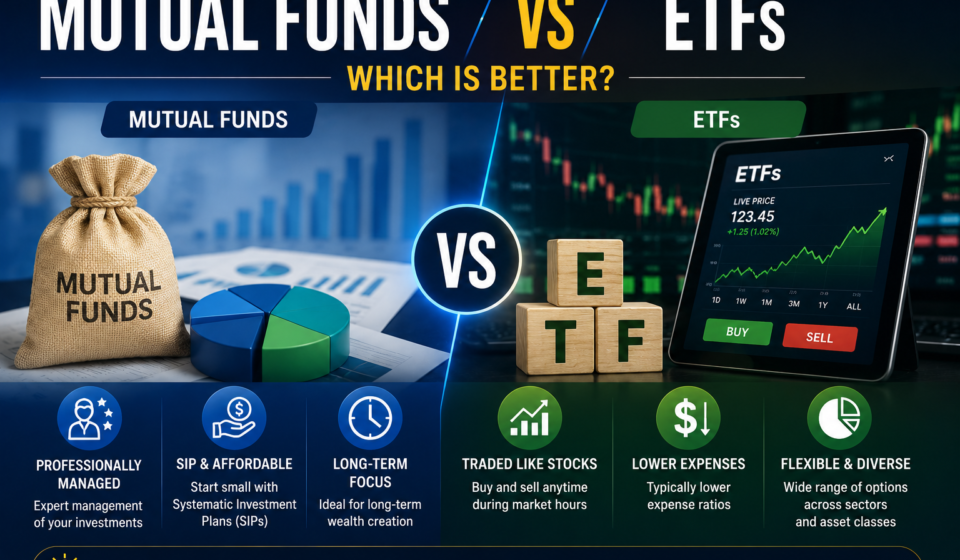

Mutual funds and exchange traded funds, commonly known as ETFs, are popular investment vehicles that allow investors to own a collection of assets through a single investment.
Both can provide diversification and access to stocks, bonds, commodities, or other securities. However, they differ in how they are bought and sold, how their prices are determined, their fee structures, tax characteristics, and minimum investment requirements.
So, which is better?
There is no universal answer. The better choice depends on an investor’s goals, preferred investment style, costs, tax situation, trading needs, and time horizon.
What Is a Mutual Fund?
A mutual fund pools money from many investors and uses that money to purchase a portfolio of securities.
A mutual fund may invest in:
- Stocks
- Bonds
- Money market instruments
- International securities
- Real estate related assets
- A combination of different investments
Professional fund managers may make investment decisions according to the fund’s stated strategy.
Some mutual funds are actively managed, while others track a particular market index.
What Is an ETF?
An exchange traded fund is an investment fund that trades on a stock exchange.
Like mutual funds, ETFs can hold a collection of securities.
An ETF may track:
- A stock market index
- A sector
- Bonds
- Commodities
- International markets
- Specific investment themes
Because ETFs trade on exchanges, investors can generally buy and sell them during market hours at market prices.
Mutual Funds vs ETFs at a Glance
The two investment types share many similarities but have important differences.
Mutual Funds
Mutual funds are generally purchased or redeemed through the fund company or an investment platform.
Their transactions are typically executed at the fund’s net asset value calculated at the end of the trading day.
ETFs
ETFs trade throughout the trading day on stock exchanges.
Their market prices can move above or below the fund’s underlying net asset value during the day.
How Are Mutual Funds and ETFs Similar?
Both mutual funds and ETFs can provide diversification.
Instead of purchasing individual securities separately, an investor can purchase one fund that owns many assets.
For example, a broad market fund may provide exposure to hundreds or thousands of companies.
Both investment types can also be designed for passive or active strategies.
Active Mutual Funds
An actively managed mutual fund has a professional manager or management team that selects investments based on the fund’s strategy.
The manager may attempt to outperform a particular benchmark.
Active management can involve more research and trading, which may contribute to higher costs.
Passive Mutual Funds
A passive mutual fund generally attempts to track an index.
Instead of selecting investments based primarily on a manager’s individual decisions, the fund follows predetermined rules based on its benchmark.
Passive funds can have relatively low operating costs.
Active ETFs
Although ETFs are often associated with index investing, some ETFs are actively managed.
An active ETF has a management team that makes investment decisions rather than simply tracking an index.
The availability and structure of active ETFs vary by market.
Passive ETFs
Passive ETFs generally track an index or predefined group of securities.
They are popular among investors seeking diversified market exposure through a single investment.
How Are Mutual Funds Priced?
Mutual funds generally transact at their net asset value.
The net asset value represents the value of the fund’s assets minus its liabilities, divided by the number of outstanding shares.
The price is generally calculated at the end of the trading day.
This means investors usually do not know the exact execution price when placing a mutual fund order during the trading day.
How Are ETFs Priced?
ETFs trade throughout the day like stocks.
Their market prices change as buyers and sellers trade shares.
An ETF can therefore have a different market price from its net asset value at a particular moment.
Market mechanisms generally help keep the ETF’s market price relatively close to the value of its underlying assets.
Which Has Lower Costs?
Costs depend on the specific fund.
Many passive ETFs have low expense ratios.
However, low cost mutual funds also exist.
Investors should examine:
- Expense ratio
- Trading costs
- Account fees
- Transaction fees
- Sales charges
- Management fees
- Other fund expenses
The lowest expense ratio is not always the only factor that matters.
What Is an Expense Ratio?
An expense ratio represents the annual operating expenses of a fund as a percentage of its assets.
For example, if a fund has an expense ratio of 0.20 percent, the fund’s operating expenses are equivalent to 0.20 percent of its average assets annually.
These costs are generally reflected in the fund’s performance rather than being billed separately to investors.
Do ETFs Have Trading Costs?
Because ETFs trade on exchanges, investors may face trading related costs.
Depending on the brokerage and market, these can include commissions and bid ask spreads.
Many modern brokerage platforms offer commission free trading for certain ETFs, but investors should still consider the bid ask spread and other costs.
Do Mutual Funds Have Trading Costs?
Some mutual funds can have transaction fees, sales charges, or other costs.
Many modern platforms offer access to certain mutual funds without transaction fees, but the specific costs vary.
Investors should always check the fund’s fee structure before investing.
Which Is More Tax Efficient?
ETFs are often considered tax efficient because of how certain ETF transactions and creations or redemptions are structured.
However, actual tax outcomes depend on the fund, the investor’s country, account type, holding period, and individual tax circumstances.
Mutual funds can also be tax efficient, particularly when they have low turnover and are structured to minimize taxable distributions.
Mutual Funds and Capital Gains
When a mutual fund sells securities at a profit, the resulting gains can potentially be distributed to shareholders.
This can create taxable events for investors holding funds in taxable accounts.
The actual tax treatment varies by jurisdiction.
ETFs and Capital Gains
ETFs can sometimes reduce the likelihood of certain taxable capital gain distributions because of their structure.
However, investors can still owe taxes when they sell ETF shares at a profit in a taxable account.
Tax rules vary by country and investment account.
Which Is Better for Long Term Investing?
Both can work well for long term investing.
A diversified low cost mutual fund may be suitable for an investor who wants a straightforward approach and does not need intraday trading.
A diversified ETF may be attractive to investors who prefer exchange trading, flexibility, and potentially low expenses.
The fund’s underlying investments often matter more than whether the investment is technically a mutual fund or ETF.
Which Is Better for Beginners?
Both can be suitable for beginners.
An investor who wants a simple buy and hold strategy may prefer a diversified mutual fund.
Another beginner may prefer an ETF because it can often be purchased like a stock and may have a low minimum investment.
The most important consideration is understanding what the fund owns and whether it matches the investor’s goals.
Which Has a Lower Minimum Investment?
ETFs can often be purchased with the price of one share, although some brokers allow fractional ETF shares.
Mutual funds can have minimum initial investment requirements, but many funds have low or no minimums depending on the platform and share class.
Minimum investment requirements vary significantly.
Which Offers More Flexibility?
ETFs generally offer greater trading flexibility because they can be bought and sold throughout the trading day.
Investors can use different order types depending on their brokerage.
Mutual fund transactions are generally processed once per trading day at the fund’s calculated net asset value.
Which Is Better for Automatic Investing?
Mutual funds have traditionally been convenient for automatic investment plans.
Investors can often set up recurring contributions to purchase fund shares.
ETFs can also be used for automated investing through many modern brokerage platforms.
The availability of automatic investing depends on the brokerage and fund.
What About Dividend Reinvestment?
Both mutual funds and ETFs can support dividend or distribution reinvestment.
When distributions are reinvested, they can be used to purchase additional shares.
Automatic reinvestment options vary by brokerage and fund.
Which Is More Diversified?
Neither structure is automatically more diversified.
Diversification depends on what the fund owns.
A broad market ETF may hold thousands of companies.
A narrowly focused mutual fund may hold a relatively small number of securities.
Investors should examine the fund’s holdings and investment objective.
Which Is Better for Retirement Accounts?
Both mutual funds and ETFs can be suitable for retirement investing, depending on the retirement account and jurisdiction.
Investors should consider:
- Fees
- Available investment choices
- Tax treatment
- Diversification
- Time horizon
- Risk tolerance
The rules differ between countries and account types.
Which Is Better for Income Investors?
Both mutual funds and ETFs can provide income through dividends, interest, or distributions.
Income depends on the underlying investments rather than simply whether the fund is an ETF or mutual fund.
Investors should examine the source and sustainability of distributions.
Which Is Better for Active Traders?
ETFs are generally more suitable for investors who want intraday trading because they trade on exchanges.
Mutual funds are generally designed more for investing rather than frequent intraday trading.
Frequent trading can increase costs and risk regardless of the investment type.
Which Is Better for Index Investing?
Both ETFs and mutual funds can track indexes.
An investor could choose an index mutual fund or an index ETF that tracks a similar benchmark.
The decision can come down to:
- Expense ratio
- Tracking difference
- Trading preferences
- Account availability
- Tax considerations
- Minimum investment
What Is Tracking Error?
Tracking error refers to the difference between a fund’s performance and the performance of its benchmark.
A fund may not perfectly match its index because of expenses, trading costs, portfolio differences, cash holdings, and other factors.
Investors comparing index funds should examine tracking performance rather than looking only at the fund’s name.
What Are Bid Ask Spreads?
The bid is the price at which buyers are willing to purchase an ETF.
The ask is the price at which sellers are willing to sell it.
The difference between these prices is called the bid ask spread.
Highly liquid ETFs often have narrower spreads, while less actively traded ETFs may have wider spreads.
Can ETFs Trade Above or Below Their Net Asset Value?
Yes.
Because ETFs trade on exchanges, their market prices can temporarily trade at a premium or discount to their net asset value.
Market mechanisms generally work to keep prices relatively close to the underlying value, but differences can occur.
What Are Mutual Fund Share Classes?
Some mutual funds offer different share classes with different fee structures and distribution arrangements.
For example, one share class may have a higher ongoing expense ratio while another may have different transaction costs.
Investors should compare the total cost of each available share class.
Are ETFs Safer Than Mutual Funds?
Neither is automatically safer.
Risk depends mainly on the underlying assets.
A diversified stock ETF can still lose significant value during a market decline.
Similarly, a stock mutual fund can experience substantial losses.
Investors should evaluate the assets, strategy, volatility, and concentration of the specific fund.
Can You Lose Money in ETFs?
Yes.
ETF prices can decline when the underlying investments lose value.
The amount of risk depends on the fund’s holdings.
A broad market ETF can experience market declines, while a concentrated sector ETF may have greater exposure to a particular industry.
Can You Lose Money in Mutual Funds?
Yes.
Mutual funds are investments and their value can fall.
Stock funds are generally exposed to equity market risk, while bond funds can face interest rate and credit risks.
Mutual Funds vs ETFs for Small Investors
Small investors can use either structure.
ETFs can be convenient because some can be purchased with a relatively small amount of money, especially when fractional shares are available.
Mutual funds may also provide low minimum investment options.
The availability depends on the investment platform and specific fund.
How to Choose Between a Mutual Fund and an ETF
Investors can compare several factors.
Investment Objective
Determine what the fund is designed to achieve.
Underlying Holdings
Review what assets the fund actually owns.
Fees
Compare expense ratios and other costs.
Trading Needs
Consider whether intraday trading is important.
Tax Considerations
Understand potential tax consequences based on the account and jurisdiction.
Minimum Investment
Check whether the fund has a minimum purchase requirement.
Historical Tracking
For index funds, examine how closely the fund has followed its benchmark.
Risk
Consider volatility, concentration, credit exposure, and other relevant risks.
Example of Choosing Between the Two
Imagine two funds provide exposure to a similar broad stock market index.
One is a mutual fund with a low expense ratio and automatic monthly investment options.
The other is an ETF with a similar expense ratio and the ability to trade throughout the day.
An investor who wants automated contributions and does not need intraday trading might prefer the mutual fund.
An investor who values exchange trading and flexibility might prefer the ETF.
Neither is automatically better.
Common Mistakes to Avoid
Choosing Based Only on Past Performance
Past performance does not guarantee future results.
Ignoring Fees
Small differences in expenses can affect long term returns.
Focusing Only on the Fund Type
An ETF is not automatically better than a mutual fund.
Ignoring Holdings
Investors should know what they are actually buying.
Trading Too Frequently
Frequent trading can increase costs and make it harder to maintain a long term investment strategy.
Ignoring Risk
Diversification reduces certain risks but does not eliminate investment losses.
Final Thoughts
Mutual funds and ETFs are both useful tools for building diversified investment portfolios.
ETFs generally provide intraday trading flexibility and are often associated with low cost index investing.
Mutual funds can offer convenient automatic investing and a wide range of active and passive strategies.
Neither structure is universally better.
The most important factors are the underlying investments, fees, diversification, tax considerations, risk, and how well the fund fits the investor’s objectives.
For many long term investors, choosing a diversified, low cost fund that matches their financial goals may matter more than choosing between an ETF and a mutual fund.
Frequently Asked Questions
What is the main difference between mutual funds and ETFs?
Mutual funds generally transact at their net asset value once per trading day, while ETFs trade on stock exchanges throughout the trading day.
Are ETFs better than mutual funds?
Not necessarily. The better option depends on the investor’s goals, costs, tax situation, trading preferences, and the specific fund.
Are mutual funds safer than ETFs?
Neither is automatically safer. Risk depends mainly on the investments held by the fund.
Do ETFs have lower fees?
Many ETFs have low expense ratios, particularly passive index ETFs, but low cost mutual funds are also available.
Can mutual funds be actively managed?
Yes. Many mutual funds are actively managed by professional investment teams.
Can ETFs be actively managed?
Yes. Some ETFs are actively managed rather than tracking an index.
Which is better for beginners?
Both can be suitable for beginners. A diversified low cost fund with an investment strategy the investor understands may be more important than the fund structure.
Can ETFs be traded during the day?
Yes. ETFs trade on stock exchanges during market hours.
Can mutual funds be traded during the day?
Mutual fund orders are generally processed at the fund’s net asset value calculated at the end of the trading day.
Which has better diversification?
Neither automatically provides better diversification. Diversification depends on the fund’s underlying holdings.
Can ETFs lose money?
Yes. ETFs can lose value when their underlying investments decline.
Can mutual funds lose money?
Yes. Mutual funds can decline in value depending on their underlying investments and market conditions.
Are ETFs good for long term investing?
They can be. Many investors use diversified ETFs as part of long term investment portfolios.
Are mutual funds good for long term investing?
They can also be suitable for long term investing, particularly when they provide diversified exposure at reasonable costs.
Which is better for automatic investing?
Mutual funds have traditionally been convenient for automatic investments, but many brokerages now offer automatic ETF investing as well.
Which is better for dividend income?
Both can provide dividend or distribution income. The amount depends on the underlying investments.
What is an expense ratio?
An expense ratio represents the annual operating expenses of a fund as a percentage of its assets.
What is net asset value?
Net asset value is the value of a fund’s assets minus its liabilities, divided by the number of outstanding shares.
Why do ETF prices change during the day?
ETF prices change as buyers and sellers trade shares on the stock exchange.
Why do mutual fund prices usually update once a day?
Mutual funds generally calculate their net asset value at the end of each trading day, and transactions are processed using that value.
Are ETFs more tax efficient?
Some ETFs can be tax efficient because of their structure, but actual tax treatment depends on the fund, investor, account, and jurisdiction.
What is an index fund?
An index fund is a mutual fund or ETF designed to track a specific market index.
What is tracking error?
Tracking error is the difference between a fund’s performance and the performance of its benchmark.
What is a bid ask spread?
The bid ask spread is the difference between the price buyers are offering and the price sellers are asking for an ETF.
Can ETFs trade above their net asset value?
Yes. ETFs can temporarily trade at a premium or discount to their net asset value.
Do mutual funds have minimum investments?
Some mutual funds have minimum investment requirements, although many have relatively low minimums.
Can investors buy fractional ETF shares?
Some brokerages allow fractional ETF shares, but availability depends on the platform.
Which is better for active trading?
ETFs are generally more suitable for active trading because they can be bought and sold throughout the trading day.
Which is better for passive investing?
Both can be effective for passive investing. Investors should compare the fund’s costs, holdings, tracking performance, and suitability.
Should investors own both mutual funds and ETFs?
They can, but there is no requirement to own both. Investors should focus on creating a diversified portfolio that matches their objectives rather than collecting multiple funds unnecessarily.
What should investors compare before choosing a fund?
They should compare the investment objective, holdings, fees, risk, diversification, tax considerations, trading characteristics, minimum investment, and historical tracking performance.


