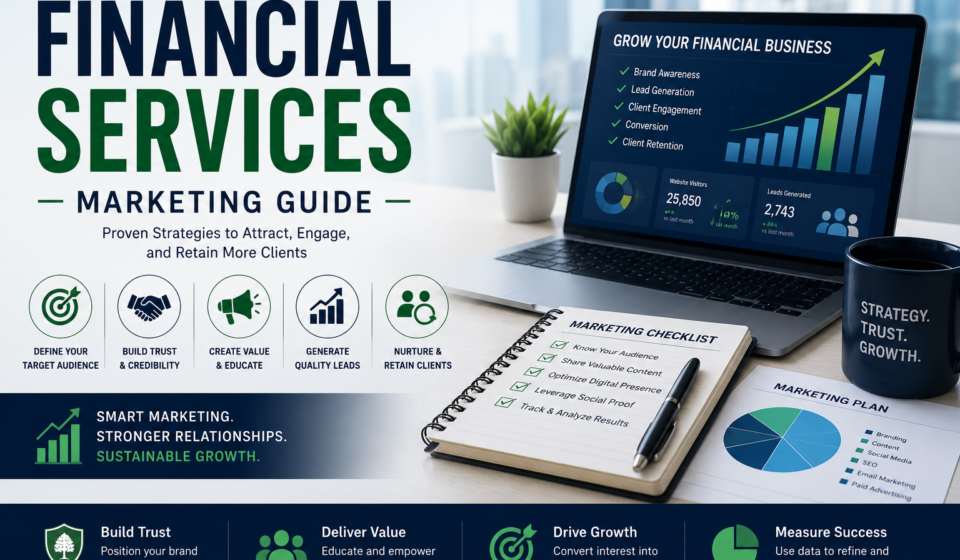

Marketing financial services is different from marketing many other products. Banks, investment companies, insurance providers, fintech businesses, lenders, payment companies, and other financial organizations need to build trust before customers are willing to share personal information or make financial decisions.
A successful financial services marketing strategy combines clear communication, strong customer experiences, useful educational content, digital channels, reputation management, and responsible messaging.
The goal is not simply to attract attention. It is to reach the right audience, explain financial products clearly, establish credibility, and encourage customers to take appropriate next steps.
What Is Financial Services Marketing?
Financial services marketing is the process of promoting financial products, services, and brands to potential and existing customers.
It can include marketing for:
- Banks
- Credit unions
- Insurance companies
- Investment firms
- Fintech companies
- Payment providers
- Mortgage providers
- Wealth management firms
- Accounting services
- Financial technology platforms
- Lending companies
Each category has different customers, regulations, and purchasing decisions.
Why Financial Services Marketing Is Different
Financial products often involve trust, risk, long term commitments, and sensitive information.
A customer may compare several companies before choosing a financial provider.
Marketing therefore needs to answer important questions such as:
- Is this company trustworthy?
- Is the product suitable for me?
- What does it cost?
- How does it work?
- What risks should I understand?
- Is my information secure?
- What happens after I sign up?
Clear answers can be more valuable than aggressive promotional messaging.
Build a Strong Financial Brand
A strong financial brand should communicate reliability, clarity, expertise, and customer value.
Start by defining:
- Target customers
- Core services
- Brand positioning
- Main customer problems
- Key differentiators
- Brand voice
- Customer promise
Avoid making the brand overly complicated.
Financial topics can already be difficult for customers to understand, so simple communication can become a competitive advantage.
Understand Your Target Audience
Effective marketing begins with knowing who you want to reach.
A financial company may serve:
- Students
- Young professionals
- Families
- Entrepreneurs
- Small businesses
- High income customers
- Investors
- Retirees
Each group may have different needs.
For example, a small business owner may care about cash flow and financing, while a young professional may be more interested in budgeting, savings, and investing.
Create Customer Personas
Customer personas can help marketers understand different audience segments.
A persona may include:
- Age range
- Occupation
- Financial goals
- Common challenges
- Product needs
- Preferred communication channels
- Buying concerns
Personas should be based on real customer research whenever possible.
Use Educational Content
Educational content is one of the strongest opportunities in financial services marketing.
Customers frequently search for explanations before choosing a financial product.
Useful topics can include:
- How savings accounts work
- How credit scores work
- What is an ETF
- How mortgages work
- How to create a budget
- What is compound interest
- How business financing works
- How digital payments work
Educational content can attract people earlier in their decision making process.
Create Beginner Friendly Guides
Financial topics can be intimidating.
Beginner guides can explain complex subjects using simple language.
Instead of assuming the reader already understands financial terminology, explain important terms clearly.
This can make the brand appear more approachable and helpful.
Use Search Marketing
Search marketing can help financial businesses reach people actively looking for information or services.
Potential search topics include:
- Financial product comparisons
- Financial calculators
- Beginner guides
- Industry questions
- Service specific information
- Local financial services
Focus on creating genuinely useful content rather than producing pages only to attract search traffic.
Build a Strong Website
A financial services website should make important information easy to find.
Useful website sections may include:
- Products
- Services
- Pricing
- FAQs
- Educational resources
- About the company
- Security information
- Customer support
- Contact information
Mobile usability is also important because many customers research financial services from smartphones.
Make Product Information Clear
Financial customers should not have to search through multiple pages to understand a product.
Clearly explain:
- What the product does
- Who it is designed for
- Fees
- Eligibility
- Key terms
- Important limitations
- Relevant risks
- How to apply or sign up
Clear product information can improve both customer confidence and user experience.
Use Social Media Carefully
Social media can help financial brands educate audiences, share company news, and communicate their personality.
Potential platforms include:
- YouTube
- X
- TikTok
The best platform depends on the audience and type of financial service.
Content should remain accurate and appropriate for the financial context.
Create Short Educational Videos
Short videos can simplify complicated financial concepts.
Examples include:
- One minute financial explanations
- Product walkthroughs
- Budgeting tips
- Market terminology
- Business finance lessons
- Frequently asked questions
Visual explanations can make financial information easier to understand.
Use Email Marketing
Email marketing can support customer education and retention.
Possible email content includes:
- Educational guides
- Product updates
- Financial tips
- Company announcements
- Personalized account information
- Customer resources
Avoid excessive promotional messages.
Useful information can help maintain long term customer engagement.
Personalize Customer Communication
Customers have different financial needs.
Personalization can help companies provide more relevant information.
For example, a business customer may receive content about cash flow management, while an individual customer may receive educational information about savings or investing.
Personalization should always respect privacy requirements and customer preferences.
Build Trust Through Transparency
Trust is particularly important in financial services.
Companies can build trust by being transparent about:
- Fees
- Terms
- Eligibility
- Risks
- Data practices
- Security
- Customer support
- Regulatory information
Avoid unclear language that could cause customers to misunderstand a financial product.
Manage Online Reputation
Customers often research a financial company before doing business with it.
They may look at:
- Customer reviews
- Ratings
- News coverage
- Social media
- Search results
- Industry discussions
Financial businesses should monitor their online reputation and respond professionally to customer concerns.
The goal should be to build genuine customer trust rather than manipulate public feedback.
Encourage Genuine Customer Feedback
Real customer feedback can provide useful insight into the customer experience.
Businesses can request reviews from customers after appropriate interactions or completed services.
Feedback can help identify:
- Service problems
- Communication issues
- Product concerns
- Support quality
- Customer satisfaction
A consistent feedback process can also help businesses understand what customers value.
Respond to Negative Feedback Professionally
Negative feedback is unavoidable for many businesses.
A professional response should:
- Acknowledge the concern.
- Remain calm.
- Avoid revealing private information.
- Provide a useful next step.
- Move sensitive discussions to an appropriate private channel.
A thoughtful response can demonstrate that the company takes customer concerns seriously.
Use Reputation Content
Financial companies can publish content that demonstrates expertise.
Examples include:
- Market explainers
- Financial education articles
- Customer success stories
- Industry research
- Expert interviews
- Company announcements
- Educational reports
Reputation content can strengthen brand credibility when supported by accurate information.
Use Public Relations
Public relations can help financial companies communicate important developments.
PR opportunities may include:
- Product launches
- Funding announcements
- Research reports
- Executive appointments
- Partnerships
- Industry insights
- Company milestones
PR should focus on genuine news and useful information.
Thought Leadership Marketing
Financial professionals can build authority by sharing informed perspectives.
Thought leadership may involve:
- Market commentary
- Industry analysis
- Educational articles
- Expert interviews
- Conference participation
- Research reports
Strong thought leadership should provide useful insights rather than simply promote a company.
Use LinkedIn for B2B Financial Marketing
LinkedIn can be particularly useful for financial businesses targeting companies and professionals.
Content can include:
- Industry insights
- Business finance guides
- Company research
- Executive perspectives
- Case studies
- Product education
Employees and executives can also contribute to the company’s professional presence.
Use Video and Webinars
Webinars can help financial businesses explain complex topics in more depth.
Possible webinar topics include:
- Business financing
- Investment education
- Financial planning
- Retirement planning
- Digital banking
- Financial technology
- Risk management
Webinars can also provide opportunities for customers to ask questions.
Build Landing Pages for Specific Services
A single generic website page may not effectively communicate every service.
Create focused pages for different audiences and needs.
For example:
- Business banking
- Personal banking
- Investment services
- Business lending
- Payment services
- Insurance
- Wealth management
Each page should clearly explain the service and provide an appropriate next step.
Use Marketing Automation
Marketing automation can help financial companies manage repetitive communication.
Automation can support:
- Email sequences
- Lead nurturing
- Appointment reminders
- Customer onboarding
- Educational campaigns
- Follow up messages
Automation should improve customer experience rather than create unnecessary communication.
Measure Customer Acquisition Cost
Customer acquisition cost measures how much a company spends to acquire customers.
Track marketing and sales expenses against the number of customers acquired.
Comparing acquisition costs across channels can help companies identify more efficient marketing strategies.
Measure Customer Lifetime Value
Customer lifetime value estimates the financial value a customer may generate over the relationship.
Comparing customer lifetime value with acquisition cost can provide useful insight into marketing efficiency.
Financial services companies with long customer relationships may benefit significantly from strong retention.
Focus on Customer Retention
Acquiring customers is only one part of marketing.
Retention can be improved through:
- Reliable service
- Helpful communication
- Easy account management
- Responsive support
- Personalized education
- Useful financial tools
Customers who have positive experiences may be more likely to continue using a service.
Use Referral Marketing
Satisfied customers may recommend financial services to friends, family, colleagues, or other businesses.
Referral programs can encourage recommendations where permitted and appropriate.
Any referral incentives should be communicated clearly and comply with applicable regulations.
Create Financial Tools
Interactive tools can provide practical value.
Examples include:
- Budget calculators
- Loan calculators
- Savings calculators
- Retirement calculators
- Investment planning tools
Tools can also help customers understand financial concepts before contacting a provider.
Optimize Customer Onboarding
Marketing should not stop when a customer signs up.
The onboarding experience can influence long term retention.
A strong onboarding process can explain:
- How to use the product
- Where to find support
- Important account features
- Security practices
- Available resources
- Next steps
Use Customer Data Responsibly
Financial marketing often involves sensitive information.
Businesses should follow applicable privacy and data protection requirements.
Use customer information responsibly and communicate clearly about data collection and usage.
Trust can be damaged quickly if customers feel their information is being used improperly.
Follow Financial Advertising Rules
Financial marketing can be subject to industry specific laws and regulations.
Requirements can vary based on:
- Country
- Financial product
- Advertising channel
- Target audience
- Company type
- Regulatory status
Marketing teams should work with appropriate compliance and legal professionals when necessary.
Avoid Misleading Financial Claims
Financial companies should avoid unsupported claims about:
- Guaranteed returns
- Guaranteed approval
- Risk free investments
- Guaranteed savings
- Guaranteed profits
- Market performance
Marketing should present financial information accurately and clearly.
Create a Consistent Content Calendar
A content calendar can help financial businesses maintain consistent communication.
A monthly calendar could include:
- Educational articles
- Social media posts
- Short videos
- News commentary
- Customer resources
- Email newsletters
- Industry reports
Consistency is generally more sustainable than publishing large amounts of content irregularly.
Common Financial Marketing Mistakes
Using Too Much Jargon
Technical terminology can make financial products difficult to understand.
Focusing Only on Sales
Customers often need education before they are ready to purchase.
Ignoring Reputation
Customers may research a company extensively before becoming a customer.
Hiding Important Information
Unclear fees and terms can damage trust.
Publishing Unverified Claims
Financial information needs to be accurate.
Ignoring Existing Customers
Retention is an important part of sustainable growth.
Treating Every Customer the Same
Different customers have different needs.
Ignoring Compliance
Financial marketing may be subject to strict requirements.
A Simple Financial Services Marketing Strategy
A practical strategy can include:
- Define your target audience.
- Identify customer problems.
- Build a clear brand message.
- Create useful educational content.
- Improve the website experience.
- Build service specific landing pages.
- Use appropriate social media channels.
- Develop email campaigns.
- Encourage genuine customer feedback.
- Monitor online reputation.
- Use PR and thought leadership where appropriate.
- Measure acquisition and retention.
- Review marketing performance regularly.
- Ensure campaigns meet applicable requirements.
Final Thoughts
Financial services marketing is ultimately about helping customers understand financial products and feel confident making informed decisions.
Successful financial brands combine education, transparency, trust, customer service, digital experiences, and responsible marketing.
The strongest strategies do not simply ask customers to buy. They answer questions, explain complicated topics, demonstrate expertise, and provide useful experiences throughout the customer journey.
As financial services continue to become more digital, companies that combine technology with clear communication and genuine customer value may be better positioned to build lasting relationships.
Frequently Asked Questions
What is financial services marketing?
Financial services marketing is the promotion of financial products and services such as banking, lending, insurance, investing, payments, and financial technology.
Why is trust important in financial marketing?
Customers share sensitive information and make important financial decisions, so trust can strongly influence whether they choose a financial provider.
What are the best marketing channels for financial services?
Common channels include websites, search marketing, email, social media, educational content, public relations, webinars, video, and referral marketing.
How can financial companies build trust?
Transparency, accurate information, clear pricing, useful education, strong customer support, responsible data practices, and professional reputation management can help build trust.
Is content marketing effective for financial services?
Yes. Educational content can help customers understand financial topics and discover a company while researching their options.
What type of content works well for financial companies?
Beginner guides, financial explainers, calculators, research reports, videos, FAQs, expert insights, and educational articles can be useful.
How can a financial company improve its online reputation?
Monitor reviews and online discussions, respond professionally to customer concerns, provide excellent service, and encourage genuine customer feedback.
Should financial companies use social media?
Social media can help financial companies educate customers, communicate company information, and build professional visibility.
Is email marketing useful for financial services?
Email marketing can support education, customer engagement, onboarding, retention, and communication when used responsibly.
What is customer acquisition cost?
Customer acquisition cost is the average amount a business spends to acquire a customer.
What is customer lifetime value?
Customer lifetime value estimates the value a customer may generate during their relationship with a company.
Why is customer retention important?
Retaining customers can support recurring revenue and reduce the need to continually spend money acquiring new customers.
How can financial companies use video marketing?
Video can simplify complex financial concepts through tutorials, product explanations, expert discussions, short educational videos, and webinars.
What is thought leadership in financial marketing?
Thought leadership involves sharing useful expertise, analysis, research, and informed perspectives about financial topics or industry developments.
Can financial companies use influencer marketing?
Some financial companies use creators and influencers, but campaigns should follow applicable advertising, disclosure, financial promotion, and platform requirements.
What should financial marketing avoid?
Financial marketers should avoid misleading claims, unclear pricing, unsupported guarantees, exaggerated results, and communication that could cause customers to misunderstand financial products.
Why is compliance important in financial marketing?
Financial products and services can be regulated, and marketing communications may need to meet specific legal and industry requirements.
How can fintech companies market themselves?
Fintech companies can combine educational content, product demonstrations, digital advertising, search marketing, public relations, social media, partnerships, and customer education.
How can a financial company improve its website?
The website should clearly explain products, pricing, eligibility, terms, security information, customer support, and next steps while providing a good mobile experience.
What is reputation management in financial services?
It is the process of monitoring and improving how customers and the public perceive a financial company across reviews, search results, media, social platforms, and other channels.
What is referral marketing?
Referral marketing encourages existing customers or partners to recommend a financial service to others where appropriate and permitted.
Are financial marketing rules the same everywhere?
No. Requirements can vary significantly by country, financial product, company type, audience, and marketing channel.
How often should a financial marketing strategy be reviewed?
Marketing performance can be reviewed regularly, while the overall strategy should be reassessed when customer behavior, regulations, products, competition, or business objectives change.
What is the most important part of financial services marketing?
There is no single tactic that works for every company, but clear communication, customer trust, useful education, responsible marketing, and a strong customer experience are fundamental.