
The way people manage money has changed dramatically over the past few decades. Traditional banking, which once required customers to visit physical branches for almost every transaction, has evolved into a digital experience that allows individuals and businesses to access financial services from virtually anywhere. Online banking has become one of the most significant innovations in modern finance, providing convenience, speed, accessibility, and greater control over personal finances.
Today, millions of people use online banking platforms to check account balances, transfer money, pay bills, apply for loans, manage investments, and perform countless other financial tasks without visiting a bank branch. The growth of smartphones, internet connectivity, and financial technology has transformed online banking from a convenience into an essential component of everyday financial life.
Despite its widespread use, many people still wonder how online banking actually works behind the scenes. Understanding the technology, security measures, features, and processes involved can help consumers make informed decisions and use digital banking services more effectively.
This guide explains how online banking works, its features, benefits, security measures, challenges, and its growing role in the future of financial services.
What Is Online Banking?
Online banking, also known as internet banking or digital banking, refers to the use of internet-connected devices to access and manage banking services electronically.
Instead of visiting physical bank branches, customers can perform various financial activities through websites, mobile applications, or other digital platforms provided by financial institutions.
Online banking allows customers to access their accounts twenty-four hours a day from virtually any location with internet access.
These services include checking account balances, transferring funds, paying bills, depositing checks, applying for financial products, viewing transaction histories, and managing investments.
Online banking has become a fundamental part of modern financial services because it offers convenience, efficiency, and accessibility to consumers and businesses alike.
The Evolution of Online Banking
Banking services have continuously evolved alongside technological advancements.
Traditional banking relied heavily on physical branches, paper records, and face-to-face interactions. The introduction of automated teller machines represented one of the first major steps toward digital banking.
As internet access expanded during the late twentieth century, banks began offering online account access and electronic transaction capabilities.
Mobile technology further accelerated the growth of online banking by allowing customers to manage finances through smartphones and tablets.
Today, digital banking platforms incorporate advanced technologies such as artificial intelligence, biometric authentication, cloud computing, and real-time payment systems.
The evolution of online banking continues to reshape how individuals and businesses interact with financial institutions.
How Online Banking Works
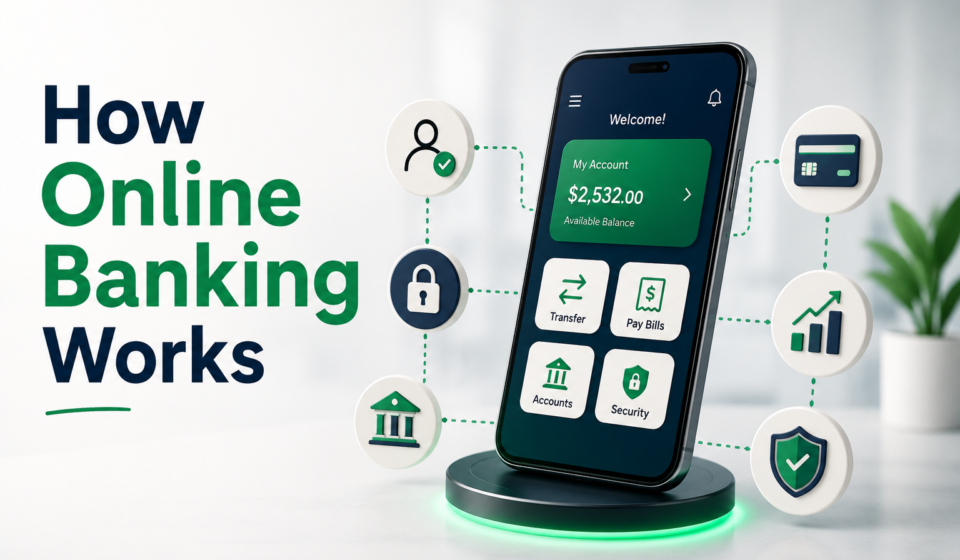
Online banking operates through secure digital networks that connect customers, financial institutions, payment systems, and financial databases.
When a customer logs into an online banking platform, the system verifies their identity using authentication procedures. Once access is granted, the customer can interact with banking services through a secure interface.
Every transaction request, such as transferring funds or paying bills, is encrypted and transmitted through secure communication channels.
The bank’s internal systems process the request, verify account balances, perform fraud detection checks, and update financial records accordingly.
Confirmation messages and transaction details are then returned to the customer through the online platform.
Modern online banking systems can process millions of transactions efficiently while maintaining security, accuracy, and regulatory compliance.
Creating an Online Banking Account
To access online banking services, customers typically register through their financial institution’s website or mobile application.
The registration process generally involves verifying identity, linking existing accounts, creating login credentials, and establishing security settings.
Customers may be required to provide personal information, identification documents, account numbers, and contact details.
Once registration is completed, users receive access credentials that allow them to log into the online banking platform.
Additional security measures, such as multi-factor authentication, may be required during the setup process.
After activation, customers can begin managing their financial accounts digitally.
The registration process helps ensure that only authorized individuals gain access to financial information.
Logging Into an Online Banking Platform
Accessing online banking services requires authentication procedures designed to protect customer accounts.
Most online banking platforms require users to enter a username, account number, or email address along with a password.
Many financial institutions also use multi-factor authentication systems that require additional verification methods.
These methods may include one-time security codes, biometric authentication, authentication applications, or device verification procedures.
Authentication helps prevent unauthorized access and protects sensitive financial information.
Once authentication is completed successfully, users gain access to their account dashboards and banking services.
Strong authentication systems represent a critical component of online banking security.
Checking Account Information
One of the primary functions of online banking is providing real-time access to account information.
Customers can view checking account balances, savings balances, transaction histories, loan information, and credit account details.
Online platforms often display detailed transaction records, account statements, spending patterns, and financial summaries.
Real-time access to financial information helps individuals monitor spending, identify unusual activity, and make informed financial decisions.
Businesses also rely on online banking systems to manage cash flow, payroll, and operational expenses.
Immediate access to financial information improves convenience and financial management capabilities.
Transferring Money Through Online Banking
Money transfers represent one of the most frequently used online banking services.
Customers can transfer funds between their own accounts, send money to other individuals, pay businesses, or conduct international transactions.
When a transfer request is submitted, the banking system verifies account ownership, available balances, and transaction authorization.
The transfer is then processed through internal banking networks or external payment systems.
Many domestic transfers are completed quickly, while international transfers may require additional processing time.
Digital payment systems have significantly improved the speed and efficiency of money movement across financial institutions.
Online banking has transformed how people send and receive money.
Online Bill Payments
Online banking platforms commonly provide bill payment services.
Customers can use these services to pay utilities, credit cards, loans, insurance premiums, subscriptions, and other recurring expenses.
Users may schedule one-time or recurring payments according to their financial needs.
The banking system processes payment instructions and transfers funds to the designated recipient.
Automated bill payment features help reduce missed payments and simplify financial management.
Many consumers prefer online bill payment systems because they eliminate the need for paper checks and manual processing.
Digital bill payment has become an essential feature of modern banking.
Mobile Banking Applications
Mobile banking applications represent one of the fastest-growing segments of digital financial services.
These applications allow customers to access banking services through smartphones and tablets.
Mobile banking apps often provide features such as balance inquiries, transfers, bill payments, budgeting tools, investment management, and financial alerts.
Many applications also support biometric authentication methods such as fingerprint recognition and facial identification.
The convenience of mobile banking has contributed significantly to the widespread adoption of digital financial services.
Consumers increasingly expect banking services to be accessible anytime and anywhere.
Mobile technology continues to drive innovation within the banking industry.
Online Deposits and Mobile Check Deposits
Many online banking platforms allow customers to deposit funds electronically.
Mobile check deposit technology enables users to deposit checks by photographing them using smartphone cameras.
Image recognition technology verifies check information and transmits the data securely to the bank’s processing systems.
Banks then review, validate, and process the deposit electronically.
This technology eliminates the need to visit physical branches for many deposit transactions.
Electronic deposit services improve convenience and reduce processing times.
Advancements in digital imaging and financial technology have significantly expanded remote banking capabilities.
Security Measures in Online Banking
Security remains one of the most important aspects of online banking.
Financial institutions invest heavily in technologies designed to protect customer information and prevent fraud.
Encryption technology protects sensitive data during transmission between users and banking systems.
Multi-factor authentication provides additional layers of security beyond passwords.
Fraud detection systems continuously monitor account activity for suspicious transactions.
Biometric authentication technologies help verify customer identities more accurately.
Banks also use firewalls, intrusion detection systems, artificial intelligence, and cybersecurity teams to defend against threats.
Maintaining trust and security remains essential for successful online banking operations.
Benefits of Online Banking
Online banking offers numerous advantages for consumers and businesses.
Convenience represents one of the most significant benefits, allowing users to access financial services without visiting physical branches.
Online banking provides continuous access to account information and financial services.
Digital platforms often process transactions more quickly than traditional methods.
Many online banking services reduce paperwork and administrative requirements.
Financial management tools, budgeting features, and spending analysis capabilities help users improve financial decision-making.
Businesses benefit from improved cash flow management and operational efficiency.
Online banking has increased accessibility and transformed customer expectations regarding financial services.
Challenges and Risks of Online Banking
Despite its advantages, online banking also presents certain challenges and risks.
Cybersecurity threats remain a significant concern for financial institutions and consumers.
Phishing attacks, malware, identity theft, and account fraud can compromise financial information.
Technical failures or internet connectivity issues may temporarily disrupt access to banking services.
Some customers may encounter difficulties adapting to digital technologies or navigating complex online interfaces.
Privacy concerns related to financial data collection and storage also require careful management.
Financial institutions continuously invest in security improvements to address evolving risks and maintain customer confidence.
Understanding these risks helps consumers use online banking more safely.
Online Banking and Financial Inclusion
Online banking has contributed significantly to expanding access to financial services.
Individuals living in remote areas or regions with limited banking infrastructure can access financial services through internet-connected devices.
Digital banking reduces geographic barriers and lowers operating costs for financial institutions.
Mobile banking services have particularly improved financial access in developing economies.
Greater financial inclusion supports economic development, entrepreneurship, and personal financial stability.
Online banking technologies continue to create opportunities for underserved populations to participate in the formal financial system.
Financial accessibility remains an important objective of digital banking innovation.
Artificial Intelligence in Online Banking
Artificial intelligence increasingly plays a role in online banking operations.
AI systems help financial institutions detect fraud, assess risk, automate customer service, and personalize financial recommendations.
Chatbots and virtual assistants provide customers with immediate support and account information.
Machine learning algorithms analyze transaction patterns to identify suspicious activity.
Artificial intelligence also supports credit evaluation, investment advice, and financial planning services.
As technology advances, AI is expected to play an even larger role in improving efficiency, security, and customer experience within digital banking.
The integration of artificial intelligence continues to transform financial services.
The Future of Online Banking
Online banking continues to evolve rapidly.
Emerging technologies such as blockchain, artificial intelligence, biometric authentication, cloud computing, and real-time payment systems are shaping the future of financial services.
Customers increasingly expect personalized, seamless, and mobile-first banking experiences.
Open banking initiatives are creating opportunities for greater financial innovation and competition.
Digital currencies and decentralized financial technologies may further transform how financial transactions occur.
Traditional banks continue investing heavily in digital transformation to remain competitive.
The future of banking will likely emphasize accessibility, automation, security, and personalized financial services.
Conclusion
Online banking has fundamentally transformed how individuals and businesses manage their finances. By providing secure, convenient, and accessible financial services through digital platforms, online banking has become an essential component of modern financial life.
The technology behind online banking combines advanced security systems, digital networks, payment infrastructure, and financial software to deliver efficient banking services around the world.
Although online banking presents certain risks and challenges, ongoing technological innovation continues to improve security, accessibility, and customer experience.
As financial technology continues to evolve, online banking will remain a central force shaping the future of global finance and financial inclusion.
Understanding how online banking works helps consumers use these services confidently while making informed financial decisions in an increasingly digital world.
Frequently Asked Questions
What is online banking?
Online banking is the use of internet-connected platforms to access and manage banking services electronically.
How does online banking work?
Online banking uses secure digital networks to connect customers with financial institutions and process financial transactions.
Is online banking safe?
Most online banking platforms use encryption, authentication, and fraud detection systems to protect customer information.
What services can I access through online banking?
Customers can check balances, transfer money, pay bills, deposit checks, apply for loans, and manage investments.
What is mobile banking?
Mobile banking refers to accessing banking services through smartphone or tablet applications.
Can I deposit checks using online banking?
Many banks offer mobile check deposit services that allow customers to deposit checks electronically.
What is multi-factor authentication?
Multi-factor authentication requires multiple forms of identity verification to improve account security.
What is the future of online banking?
The future of online banking will likely involve artificial intelligence, biometric security, real-time payments, and increased digital innovation.