
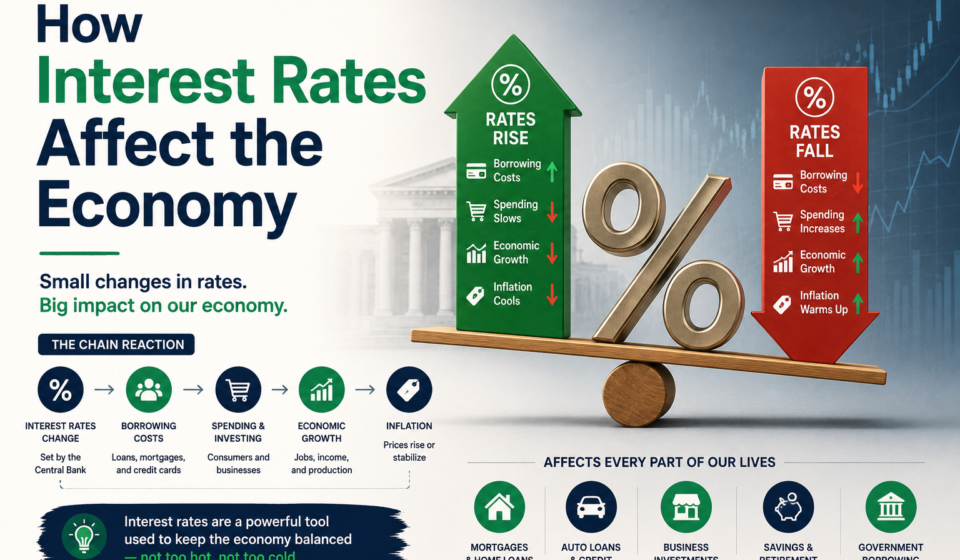

Interest rates play a central role in the global economy and influence nearly every aspect of financial life. From personal loans and mortgages to business investments, stock markets, inflation, and government spending, interest rates affect how money moves through an economy. Although many people encounter interest rates through savings accounts or borrowing, their broader economic impact extends far beyond individual financial decisions.
Governments, central banks, businesses, investors, and consumers closely monitor interest rates because changes in borrowing costs can significantly influence economic growth and financial stability. When interest rates rise or fall, they affect spending behavior, investment decisions, employment opportunities, and market performance.
Understanding how interest rates affect the economy helps individuals make better financial decisions while providing insight into why economic conditions change over time. Whether purchasing a home, investing in financial markets, operating a business, or planning for retirement, understanding interest rates is an essential component of financial literacy.
This guide explains what interest rates are, how they work, who controls them, and how they influence various sectors of the economy.
What Are Interest Rates?
An interest rate is the cost of borrowing money or the reward for saving money. It is typically expressed as a percentage of the principal amount over a specific period.
When individuals or businesses borrow money, they pay interest to lenders as compensation for providing capital. Conversely, when people deposit money into savings accounts or purchase certain investments, they may earn interest as compensation for allowing others to use their funds.
Interest rates exist because money has value over time. Lenders expect compensation for delaying their own use of money and accepting the risk that borrowers may not repay their obligations.
Interest rates serve as a fundamental mechanism that influences financial decisions throughout the economy.
Who Controls Interest Rates?
In most countries, central banks play a significant role in influencing interest rates.
Central banks are responsible for maintaining economic stability, managing inflation, supporting employment, and overseeing monetary policy. They use benchmark interest rates as a primary tool for achieving these objectives.
For example, the Federal Reserve System influences interest rates in the United States, while the Reserve Bank of India performs a similar role in India.
Although central banks establish benchmark rates, financial institutions determine the specific rates offered on loans, mortgages, savings accounts, and other financial products.
Market conditions, inflation expectations, economic growth, and investor sentiment also influence interest rate movements.
Why Central Banks Change Interest Rates
Central banks adjust interest rates to manage economic activity.
When economic growth slows or unemployment rises, central banks may reduce interest rates to encourage borrowing, spending, and investment.
Lower interest rates make loans less expensive, which can stimulate consumer spending and business expansion.
Conversely, when inflation rises too rapidly or economic activity becomes excessive, central banks may increase interest rates.
Higher interest rates discourage borrowing and spending, helping reduce inflationary pressures.
This process of adjusting interest rates forms a key component of monetary policy and economic management.
Balancing economic growth and inflation remains one of the primary objectives of central banking.
How Lower Interest Rates Affect the Economy
Lower interest rates generally encourage economic activity.
When borrowing costs decline, consumers often become more willing to purchase homes, vehicles, and other goods financed through loans.
Businesses may increase investments in equipment, technology, expansion projects, and hiring because financing becomes more affordable.
Lower interest rates can also stimulate housing markets by making mortgages more accessible.
Investors may shift money from low-yield savings products toward stocks and other assets that offer potentially higher returns.
Increased spending and investment can contribute to economic growth, higher employment levels, and increased business activity.
However, prolonged periods of very low interest rates may also contribute to inflation and asset price bubbles.
How Higher Interest Rates Affect the Economy
Higher interest rates generally slow economic activity.
As borrowing becomes more expensive, consumers may reduce spending on homes, vehicles, and discretionary purchases.
Businesses may postpone expansion plans, reduce investments, or limit hiring due to increased financing costs.
Higher interest rates can also reduce consumer confidence and decrease overall demand within the economy.
Investors may become more attracted to lower-risk savings and fixed-income investments that offer improved returns.
Although higher interest rates can slow economic growth, they often help control inflation and maintain long-term economic stability.
Central banks frequently raise interest rates when inflation becomes a significant concern.
Interest Rates and Inflation
Interest rates and inflation are closely interconnected.
Inflation refers to the increase in prices of goods and services over time. Moderate inflation is generally considered a normal component of economic growth.
When inflation rises too quickly, central banks often increase interest rates to reduce spending and borrowing.
Higher borrowing costs can slow consumer demand and business activity, helping stabilize prices.
Conversely, when inflation is low or economic activity weakens, central banks may lower interest rates to stimulate spending and encourage growth.
Managing inflation through interest rate adjustments remains one of the most important responsibilities of monetary policymakers.
Maintaining price stability supports long-term economic health and financial confidence.
Interest Rates and Consumer Spending
Consumer spending represents a major component of economic activity.
Interest rates influence consumer behavior by affecting the cost of borrowing and the attractiveness of saving.
Lower interest rates generally encourage consumers to finance purchases, spend more freely, and reduce savings.
Higher interest rates often encourage saving while discouraging borrowing and discretionary spending.
Credit card interest rates, personal loans, auto loans, and mortgages all influence household financial decisions.
Changes in consumer spending can significantly affect business revenues, employment, and overall economic performance.
Because consumer spending drives substantial portions of many economies, interest rates have far-reaching economic effects.
Interest Rates and Mortgage Markets
The housing market is particularly sensitive to interest rate changes.
Mortgage interest rates directly affect the affordability of home purchases and refinancing decisions.
Lower mortgage rates reduce monthly payments, making homeownership more accessible and increasing housing demand.
Higher mortgage rates increase borrowing costs and may reduce home affordability, slowing housing market activity.
Changes in housing demand can influence construction, real estate services, home improvement industries, and employment.
Housing markets often serve as important indicators of broader economic conditions.
Interest rate movements can therefore have substantial effects on both individual households and the overall economy.
Interest Rates and Business Investment
Businesses rely on financing to support operations, expansion, and innovation.
Interest rates influence business decisions by affecting the cost of borrowing capital.
When interest rates are low, businesses may invest more aggressively in equipment, technology, facilities, research, and workforce expansion.
Higher interest rates increase financing costs and may lead businesses to postpone investments or reduce expenditures.
Business investment contributes significantly to economic growth, productivity improvements, and job creation.
Interest rate changes therefore affect not only individual businesses but also broader economic performance and competitiveness.
Corporate investment decisions are closely linked to monetary policy conditions.
Interest Rates and Employment
Employment levels are indirectly affected by interest rate changes.
Lower interest rates can stimulate economic activity, encourage business expansion, and increase hiring opportunities.
As companies invest and expand operations, demand for workers often increases.
Conversely, higher interest rates may reduce business activity and slow hiring.
Economic slowdowns caused by rising borrowing costs can contribute to increased unemployment.
Central banks often consider employment conditions when making interest rate decisions.
Balancing inflation control with employment growth represents one of the primary challenges of monetary policy management.
Interest rate decisions can therefore have significant social and economic consequences.
Interest Rates and the Stock Market
Interest rates strongly influence stock market performance.
Lower interest rates often support stock prices because businesses face lower financing costs and investors seek higher returns than those available through savings products.
Reduced interest rates may increase corporate profits and encourage investment in equities.
Higher interest rates can create challenges for stock markets.
As borrowing costs rise, business profitability may decline, and investors may shift capital toward fixed-income investments offering improved returns.
Growth-oriented companies often experience greater sensitivity to interest rate changes due to their reliance on future earnings expectations.
Although stock markets respond to numerous factors, interest rates remain among the most important influences.
Interest Rates and Bond Markets
Bond markets are directly affected by interest rate movements.
Bond prices and interest rates generally move in opposite directions.
When interest rates rise, existing bonds with lower interest payments often become less attractive, causing their market values to decline.
Conversely, when interest rates fall, existing bonds with higher interest payments may increase in value.
Investors frequently adjust their bond portfolios based on expectations regarding future interest rate movements.
Understanding the relationship between interest rates and bonds is important for managing investment risk and portfolio diversification.
Bond markets play a critical role in the broader financial system and economy.
Interest Rates and Savings
Interest rates affect saving behavior by influencing potential returns on deposits and savings products.
Higher interest rates generally encourage saving because individuals can earn greater returns on their deposits.
Lower interest rates may discourage saving and encourage spending or investment in alternative assets.
Savings behavior influences capital formation, investment activity, and long-term economic growth.
Retirees and conservative investors often pay close attention to interest rates because they rely on income generated from savings and fixed-income investments.
Changes in savings behavior can affect financial institutions and overall economic activity.
Interest rates therefore influence both spending and saving decisions.
Interest Rates and Currency Values
Interest rates can significantly affect currency markets.
Countries with relatively higher interest rates may attract foreign investment because investors seek better returns.
Increased demand for a country’s financial assets can strengthen its currency.
Conversely, lower interest rates may reduce foreign investment demand and weaken currency values.
Exchange rate movements influence international trade, inflation, exports, imports, and economic competitiveness.
Central banks often consider exchange rate effects when making monetary policy decisions.
Global financial markets closely monitor interest rate differences among countries.
Currency movements demonstrate the international impact of domestic monetary policy decisions.
Interest Rates During Economic Recessions
Economic recessions often prompt central banks to reduce interest rates.
Lower borrowing costs can encourage spending, investment, and economic recovery.
During severe economic downturns, central banks may implement unusually low interest rates to stimulate activity.
However, low interest rates alone may not always generate rapid economic recovery if consumer confidence and business investment remain weak.
Governments and central banks may combine monetary policy with fiscal measures to support economic growth.
The effectiveness of interest rate policies during recessions depends on numerous economic and financial factors.
Managing recessions remains one of the most challenging aspects of economic policy.
The Global Impact of Interest Rates
Interest rate decisions in major economies often affect financial markets worldwide.
Global investors frequently move capital across borders in response to changing interest rate conditions.
International trade, investment flows, exchange rates, and financial markets can all be influenced by monetary policy decisions in large economies.
Global economic interdependence means that interest rate changes in one country may create ripple effects throughout the international financial system.
Businesses, governments, investors, and policymakers closely monitor global interest rate trends.
Understanding these relationships helps explain the interconnected nature of modern economies.
Conclusion
Interest rates represent one of the most powerful forces shaping economic activity and financial markets. They influence borrowing, saving, spending, investing, employment, inflation, housing markets, business decisions, and global financial systems.
Central banks use interest rates as essential tools for managing economic growth and maintaining financial stability. Changes in interest rates affect individuals, businesses, governments, and investors in numerous ways.
Understanding how interest rates affect the economy helps individuals make informed financial decisions and better understand changing economic conditions. Whether managing personal finances, investing, operating a business, or planning for the future, knowledge of interest rates remains an essential component of financial literacy.
As economies continue to evolve and global financial systems become increasingly interconnected, interest rates will remain a critical factor influencing economic outcomes worldwide.
Frequently Asked Questions
What is an interest rate?
An interest rate is the cost of borrowing money or the return earned on savings and investments.
Who controls interest rates?
Central banks influence benchmark interest rates, while financial institutions determine specific lending and savings rates.
Why do central banks raise interest rates?
Central banks often raise interest rates to reduce inflation and maintain economic stability.
How do lower interest rates affect the economy?
Lower interest rates generally encourage borrowing, spending, investment, and economic growth.
How do higher interest rates affect consumers?
Higher interest rates increase borrowing costs and may reduce spending and investment activity.
How do interest rates affect the stock market?
Interest rates influence corporate profits, investor behavior, and market valuations.
Why do interest rates affect mortgage payments?
Mortgage rates determine borrowing costs for home purchases and refinancing.
How do interest rates impact inflation?
Central banks use interest rate changes to influence spending and borrowing behavior, helping manage inflation levels.


