
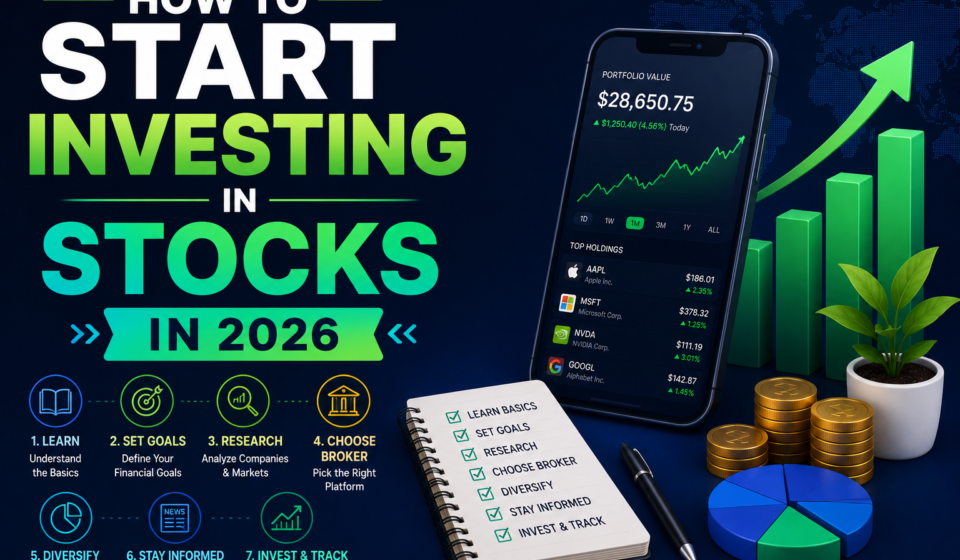

Investing in the stock market has become more accessible than ever before. With user-friendly investment platforms, fractional shares, AI-powered research tools, and a wealth of educational resources, almost anyone can begin building a portfolio with a relatively small amount of money. Whether your goal is to grow your wealth, prepare for retirement, or generate long-term financial security, investing in stocks remains one of the most effective ways to build assets over time.
However, successful investing isn’t about chasing trending stocks or trying to predict short-term market movements. It’s about understanding how the market works, managing risk, and following a disciplined strategy that aligns with your financial goals.
This guide explains everything beginners need to know about starting to invest in stocks in 2026, including how to prepare, choose investments, build a portfolio, and avoid common mistakes.
What Is Stock Investing?
When you buy a stock, you purchase a small ownership stake in a publicly traded company. As the company grows and becomes more valuable, the price of its shares may increase. Some companies also distribute a portion of their profits to shareholders through dividends.
Investors generally earn returns in two ways:
- Capital appreciation when stock prices increase.
- Dividend income from companies that share profits with investors.
Although stock prices fluctuate, investing with a long-term perspective has historically rewarded patient investors.
Why Invest in Stocks?
Stocks offer several advantages compared to simply saving money in a traditional bank account.
Benefits include:
- Long-term wealth creation
- Potential for higher returns
- Dividend income
- Protection against inflation
- Portfolio diversification
- Ownership in successful companies
- Easy access through online investment platforms
While there are risks, disciplined investing can help achieve financial goals over time.
Step 1: Define Your Financial Goals
Before purchasing your first stock, determine why you’re investing.
Common goals include:
- Building retirement savings
- Buying a home
- Funding education
- Creating passive income
- Growing long-term wealth
- Achieving financial independence
Your investment strategy should reflect your timeline and financial objectives.
Step 2: Build an Emergency Fund First
Investing should not replace financial security.
Before investing, consider building an emergency fund that covers several months of essential living expenses.
This helps prevent selling investments during market downturns to cover unexpected costs.
Step 3: Understand Your Risk Tolerance
Every investor has a different comfort level with market fluctuations.
Factors affecting risk tolerance include:
- Age
- Income stability
- Financial obligations
- Investment experience
- Time horizon
- Personal financial goals
Long-term investors can often tolerate more short-term market volatility than those needing money in the near future.
Step 4: Learn the Different Types of Stocks
Not all stocks are alike.
Common categories include:
Growth Stocks
Companies expected to grow revenue and earnings rapidly.
They often reinvest profits instead of paying dividends.
Value Stocks
Companies trading below their perceived intrinsic value.
Investors hope these stocks appreciate as the market recognizes their worth.
Dividend Stocks
Established companies that regularly distribute part of their profits to shareholders.
These can provide steady income alongside potential price appreciation.
Blue-Chip Stocks
Large, financially stable companies with strong reputations and long operating histories.
Many beginners include blue-chip stocks as core portfolio holdings.
Small-Cap Stocks
Smaller companies with higher growth potential but generally greater volatility.
Step 5: Choose the Right Investment Account
Select an investment account that matches your financial goals.
Popular options include:
- Individual brokerage accounts
- Retirement investment accounts
- Tax-advantaged savings plans (where available)
- Employer-sponsored retirement plans
Compare platforms based on:
- Fees
- Available investments
- Research tools
- Educational resources
- User experience
- Customer support
Step 6: Start with Diversification
Diversification reduces risk by spreading investments across different companies and sectors.
A diversified portfolio may include:
- Technology
- Healthcare
- Financial services
- Consumer goods
- Energy
- Industrials
- Utilities
Many beginners also invest in broad market index funds or exchange-traded funds (ETFs) that provide exposure to hundreds of companies through a single investment.
Step 7: Invest Consistently
Successful investing often depends more on consistency than timing.
Instead of waiting for the “perfect” market conditions, many investors contribute a fixed amount regularly.
This strategy, often called dollar-cost averaging, helps reduce the impact of short-term price fluctuations because investments are made at different market levels over time.
Step 8: Research Before Buying
Avoid investing based solely on social media trends or online hype.
Before purchasing a stock, evaluate:
- Business model
- Revenue growth
- Profitability
- Competitive advantages
- Industry trends
- Management quality
- Financial health
- Long-term growth potential
Understanding the company behind the stock supports better investment decisions.
Step 9: Think Long Term
Short-term price movements are normal.
Long-term investors focus on:
- Company fundamentals
- Business growth
- Consistent investing
- Portfolio diversification
Patience often produces better results than attempting to trade frequently.
Step 10: Monitor Your Portfolio Without Overreacting
Regularly review your investments to ensure they continue supporting your financial goals.
Avoid making decisions based solely on:
- Daily market news
- Temporary price declines
- Emotional reactions
- Market rumors
Long-term discipline is one of the most valuable investing skills.
Step 11: Continue Learning
Financial markets constantly evolve.
Expand your knowledge by studying:
- Company financial reports
- Economic trends
- Investment books
- Market analysis
- Portfolio management
- Risk management
- Personal finance
Continuous learning helps build confidence and improve decision-making.
Common Investing Mistakes to Avoid
Many new investors make avoidable errors.
Common mistakes include:
- Investing without clear goals
- Putting all money into one stock
- Chasing market trends
- Selling during temporary market declines
- Ignoring diversification
- Taking excessive risks
- Investing money needed for short-term expenses
- Following unverified investment tips
- Letting emotions drive decisions
Avoiding these habits can improve long-term results.
The Role of AI in Investing
Artificial intelligence is changing how investors research markets.
AI-powered tools can help with:
- Stock screening
- Market analysis
- Portfolio monitoring
- Financial news summaries
- Risk assessment
- Earnings analysis
- Investment research
While AI provides useful insights, investment decisions should still involve independent research and careful judgment.
Is 2026 a Good Time to Start Investing?
There is no universally perfect time to begin investing.
For long-term investors, starting early is often more important than trying to predict short-term market movements.
Beginning with consistent contributions, diversified investments, and realistic expectations can help build wealth over many years regardless of temporary market conditions.
Final Thoughts
Starting your investing journey in 2026 does not require large amounts of money or extensive financial expertise. What matters most is developing good habits early, understanding your goals, managing risk wisely, and maintaining a long-term perspective.
Rather than searching for the next “hot stock,” focus on building a diversified portfolio, investing consistently, and learning continuously. Markets will always experience periods of volatility, but disciplined investors who stay focused on their long-term objectives are often better positioned to achieve sustainable financial growth.
Remember that investing involves risk, and past market performance does not guarantee future results. Consider your financial situation carefully, and if needed, seek guidance from a qualified financial advisor before making investment decisions.
Frequently Asked Questions (FAQs)
1. How much money do I need to start investing in stocks in 2026?
Many investment platforms allow beginners to start with relatively small amounts, and some offer fractional shares, making it possible to invest without purchasing an entire share of an expensive company.
2. What is the best investment strategy for beginners?
A diversified, long-term approach that includes regular investing, broad market index funds or ETFs, and quality companies is often considered suitable for many beginners.
3. Should I invest in individual stocks or ETFs?
Individual stocks can offer higher growth potential but involve greater risk. ETFs provide instant diversification and are often a practical choice for new investors seeking broad market exposure.
4. Is stock investing risky?
Yes. Stock prices can rise and fall based on market conditions, economic factors, and company performance. Diversification and a long-term investment horizon can help manage risk.
5. What is dollar-cost averaging?
Dollar-cost averaging is the practice of investing a fixed amount at regular intervals regardless of market conditions. This strategy helps reduce the impact of short-term price fluctuations over time.
6. How often should I review my investment portfolio?
Reviewing your portfolio every few months or after major life changes is generally sufficient. Constant monitoring may encourage emotional decisions rather than long-term investing.
7. Can AI help with stock investing?
AI can assist with research, market analysis, portfolio tracking, and financial data interpretation. However, it should be used as a decision-support tool rather than the sole basis for investment choices.
8. What mistakes should beginner investors avoid?
Common mistakes include investing without a plan, concentrating too much money in one stock, reacting emotionally to market movements, chasing trends, and neglecting diversification.
9. Should I invest during a market downturn?
Many long-term investors continue investing during market declines because lower prices may provide opportunities to accumulate quality investments over time. The decision should always align with your financial goals and risk tolerance.
10. What is the most important principle for successful investing?
Consistency, diversification, patience, and a long-term perspective are among the most important principles. Building wealth through investing is typically a gradual process rather than a quick path to financial success.


