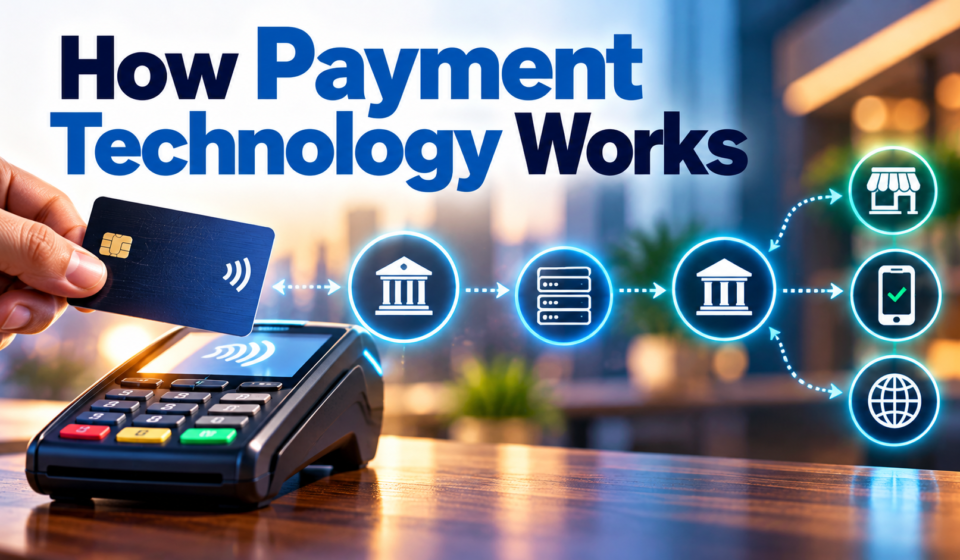

Paying for something used to mean handing over cash or writing a cheque. Today, a payment can happen in a few seconds with a card, smartphone, smartwatch, QR code, or online checkout.
Behind that simple tap or click is a network of financial institutions, payment processors, merchants, technology providers, and security systems working together.
Payment technology is the infrastructure that allows money to move between a customer and a business. It helps authorize transactions, verify identities, communicate payment information, detect suspicious activity, and transfer funds between financial institutions.
Understanding how payment technology works makes it easier to understand what happens after you tap a card, scan a QR code, or enter your card details into an online store.
What Is Payment Technology?
Payment technology refers to the systems and technologies used to initiate, process, authorize, and complete financial transactions.
It includes both physical and digital methods of payment.
Common examples include:
- Credit cards
- Debit cards
- Contactless payments
- Mobile wallets
- Bank transfers
- QR code payments
- Online payment gateways
- Digital payment applications
- Automated payment systems
Although the customer may only see a payment screen or card reader, several systems can be involved in completing the transaction.
The Four Basic Stages of a Digital Payment
A typical electronic payment can be understood through four broad stages:
Initiation → Authorization → Processing → Settlement
The exact process varies depending on the payment method, country, financial institutions involved, and payment network.
Stage 1: Initiation
The process begins when a customer chooses to make a payment.
For example, a customer may:
- Tap a contactless card
- Insert a chip card
- Enter card information online
- Scan a QR code
- Select a mobile wallet
- Initiate a bank transfer
The payment system receives the transaction request and begins processing it.
Stage 2: Authorization
The transaction information is sent through the relevant payment network to the financial institution responsible for approving or declining the transaction.
The institution may check:
- Whether the account is valid
- Whether sufficient funds or credit are available
- Whether the card is active
- Whether the transaction appears suspicious
- Whether additional verification is required
The transaction is then approved or declined.
Stage 3: Processing
Once the transaction is authorized, the relevant payment systems process the transaction details.
Different parties may be involved depending on the payment method.
The merchant’s payment provider communicates with the appropriate payment networks and financial institutions.
Stage 4: Settlement
Settlement is the stage where the funds are transferred between the relevant financial institutions.
The merchant eventually receives the money according to the payment provider’s settlement schedule.
This may happen quickly, but the exact timing varies depending on the payment method and financial institutions involved.
Who Is Involved in a Card Payment?
A card transaction may look like a direct interaction between a customer and a shop, but several parties can participate.
The main participants can include:
| Participant | Main Role |
|---|---|
| Customer | Initiates the payment |
| Merchant | Sells the product or service |
| Payment processor | Helps process transaction information |
| Acquiring institution | Handles payment acceptance for the merchant |
| Card network | Routes payment information between participants |
| Issuing bank | Provides the customer’s card or account |
| Payment gateway | Securely communicates online payment information |
Not every payment uses exactly the same participants or structure.
What Happens When You Tap a Contactless Card?
Contactless payments use near field communication technology to communicate between the payment card or device and the payment terminal.
When you tap the card:
- The payment terminal detects the card.
- The card and terminal exchange transaction information.
- Security information is generated or communicated.
- The transaction request is sent through the payment infrastructure.
- The issuing institution evaluates the transaction.
- The transaction is approved or declined.
- The merchant receives the result.
The entire interaction can happen within seconds.
Contactless payments are designed to reduce the need to physically insert or swipe a card.
How Chip Cards Work
Modern payment cards commonly contain an embedded chip.
When a chip card is inserted into a compatible terminal, the chip participates in the transaction and provides security information that helps authenticate the transaction.
This is different from older magnetic stripe transactions, where information stored on the stripe was read by the terminal.
Chip based transactions can provide stronger security mechanisms than traditional magnetic stripe transactions.
How Mobile Wallets Work
Mobile wallets allow payment credentials to be stored and used through a smartphone, smartwatch, or other compatible device.
Examples of mobile wallet technology include digital wallets offered by major technology and financial companies.
Instead of directly exposing the underlying card details during every transaction, some wallet systems use tokenization.
What Is Tokenization?
Tokenization replaces sensitive payment information with a token that can be used within an authorized payment environment.
The token does not necessarily contain the customer’s actual card number in a form that can be directly used everywhere.
This can reduce exposure of sensitive payment information during transactions.
How Online Payments Work
Online payments work differently from tapping a physical card, but the underlying principles are similar.
Imagine that you are purchasing a product from an online store.
You enter your payment information and click the payment button.
The website sends the payment information through a payment gateway or other payment infrastructure.
The payment system communicates with the relevant financial institutions or networks.
The transaction is checked and either approved or declined.
If approved, the merchant receives confirmation and can proceed with the order.
Later, the transaction goes through the applicable settlement process.
What Is a Payment Gateway?
A payment gateway is technology that helps securely transmit payment information between a merchant’s checkout environment and the payment processing system.
For an online store, the gateway can act as a communication layer between the website and the payment infrastructure.
The customer may only see a simple payment form, while the gateway handles the technical communication required to submit the transaction.
What Is a Payment Processor?
A payment processor helps facilitate the communication and processing required to complete a payment transaction.
The processor can connect merchants with financial institutions and payment networks.
Payment gateways and payment processors are sometimes discussed together, but they can serve different technical and operational functions.
In some payment solutions, multiple functions may be provided by the same company or integrated platform.
How QR Code Payments Work
QR codes have become an important payment technology in many markets.
A QR code can contain information that directs the payment application to the appropriate transaction or merchant.
A typical QR payment may work like this:
Scan QR code → Open payment application → Confirm transaction → Authenticate → Payment processed
Depending on the payment system, the customer may enter an amount, confirm a predefined amount, or authenticate using a PIN, password, fingerprint, or facial recognition.
The exact process varies between payment networks and applications.
How Bank Transfers Work
Bank transfers allow money to move directly between bank accounts.
A transfer may be initiated through:
- Mobile banking
- Internet banking
- Bank branches
- Automated payment systems
- Payment applications
The payment instructions are transmitted through the relevant banking infrastructure.
Depending on the transfer system, payments may be processed almost immediately or may take longer.
Some systems operate continuously, while others process transactions in scheduled batches.
How Payment Technology Protects Transactions
Security is one of the most important parts of modern payment technology.
Payment systems use multiple layers of protection.
Encryption
Encryption helps protect sensitive information while it is transmitted between systems.
Tokenization
Tokenization can replace sensitive payment information with a token within supported payment environments.
Authentication
Authentication helps confirm that the person initiating a transaction is authorized to do so.
This can involve:
- PINs
- Passwords
- One time passwords
- Biometrics
- Device authentication
- Multi factor authentication
Fraud Detection
Payment providers can analyze transactions for unusual patterns.
For example, a transaction may receive additional scrutiny if it differs significantly from a customer’s normal spending behavior.
Fraud detection systems can use rules, statistical models, machine learning, and other technologies to identify potentially suspicious transactions.
Why Some Payments Are Declined
A payment can be declined for many reasons.
Possible causes include:
- Insufficient funds
- Exceeded credit limit
- Incorrect payment information
- Expired card
- Blocked account
- Suspected fraud
- Network problems
- Merchant restrictions
- Authentication failure
A declined transaction does not always mean the customer has done something wrong.
Technical issues can also interrupt the payment process.
What Is Payment Authentication?
Authentication is the process of verifying that a payment is being initiated by an authorized person or device.
For example, a bank may request an additional verification step when a customer makes an online purchase.
This could involve a one time password, biometric verification, or approval through a banking application.
Authentication requirements vary by payment system and jurisdiction.
The Difference Between Payment Authorization and Settlement
These two concepts are often confused.
Authorization determines whether the transaction can proceed.
Settlement involves the actual transfer of funds between the relevant financial institutions.
For example, when you pay for a product using a card, the transaction can be approved within seconds even though the merchant may receive the funds according to a later settlement schedule.
This distinction explains why an approved transaction and the final movement of funds are not necessarily the same event.
How Payment Technology Has Changed Businesses
Modern payment systems have changed the way businesses sell products and services.
Online stores can accept payments from customers in different locations without requiring physical cash.
Businesses can also use payment technology to:
- Accept recurring payments
- Send invoices
- Process refunds
- Track transactions
- Manage subscriptions
- Accept contactless payments
- Integrate payments into mobile applications
Payment technology has therefore become part of the wider digital infrastructure used by modern businesses.
The Growth of Real Time Payments
Real time payment systems allow transactions to move between participating financial institutions much faster than traditional batch based systems.
In some systems, money can be transferred within seconds, including outside traditional banking hours.
Real time payments can make everyday transactions more convenient and can also help businesses improve cash flow.
However, instant payment systems also require strong security controls because transactions may be difficult or impossible to reverse once completed.
What Happens When You Get a Refund?
A refund reverses or returns funds from a merchant to a customer according to the payment method and transaction rules.
The merchant initiates the refund through its payment system.
The payment infrastructure then processes the transaction back through the relevant financial institutions.
The time required for the customer to see the refunded amount can vary.
A merchant may process a refund immediately while the customer’s bank takes additional time to reflect it in the account.
The Future of Payment Technology
Payment technology continues to evolve.
Several developments are shaping the industry:
Digital Wallets
Mobile devices are increasingly becoming payment tools rather than simply communication devices.
Biometric Authentication
Fingerprint, facial recognition, and other biometric technologies can make authentication more convenient.
Account to Account Payments
Direct bank account payments can provide alternatives to traditional card based transactions.
Embedded Payments
Businesses can integrate payment functionality directly into applications and digital platforms.
Artificial Intelligence
AI and machine learning can assist with fraud detection, transaction monitoring, customer support, and risk analysis.
Connected Devices
Smartwatches, vehicles, and other connected devices may increasingly support payment functionality.
Why Payment Technology Matters
Payment technology is more than a way to transfer money.
It provides the infrastructure that allows modern commerce to operate across physical stores, websites, mobile applications, and international markets.
For consumers, it provides convenience and multiple ways to pay.
For businesses, it provides tools for accepting transactions, managing customers, handling subscriptions, and operating online.
For financial institutions, payment systems create an infrastructure through which transactions can be authenticated, processed, monitored, and settled.
Final Thoughts
Every time you tap a card, scan a QR code, or click a payment button, a complex process happens behind the scenes.
Payment technology connects customers, merchants, banks, payment processors, networks, and technology platforms to move transaction information and ultimately settle funds.
Authorization determines whether a transaction can proceed. Processing moves the transaction through the relevant systems. Settlement completes the movement of funds between participating financial institutions.
Security technologies such as encryption, tokenization, authentication, and fraud detection help protect the payment ecosystem.
As financial technology continues to develop, payments are becoming faster, more digital, and increasingly integrated into everyday technology.
Understanding how these systems work provides a clearer picture of what happens behind the simple act of making a payment.
Frequently Asked Questions
What is payment technology?
Payment technology refers to the systems and tools used to initiate, authorize, process, secure, and settle financial transactions.
How does a card payment work?
A card payment begins when a customer presents or enters their card information. The transaction is sent through the relevant payment infrastructure, checked by the issuing institution, and either approved or declined. If approved, the transaction later proceeds through settlement.
What is a payment gateway?
A payment gateway is technology that securely communicates payment information between an online merchant and the relevant payment processing infrastructure.
What is the difference between a payment gateway and a payment processor?
A payment gateway primarily facilitates the secure transmission of payment information, while a payment processor helps handle the communication and processing needed to complete the transaction. In some services, both functions may be integrated.
How do contactless payments work?
Contactless payments use short range wireless communication between a compatible card or device and a payment terminal. The transaction information is then processed through the appropriate payment network.
Are mobile wallet payments secure?
Mobile wallets can use technologies such as tokenization, encryption, device authentication, and biometrics to protect payment transactions. Security depends on the specific wallet, device, payment network, and user’s security practices.
What is tokenization in payments?
Tokenization replaces sensitive payment information with a token that can be used within an authorized payment environment. This can reduce the need to expose the underlying payment details during transactions.
Why does a payment get declined?
Payments can be declined because of insufficient funds, credit limits, incorrect information, fraud detection, authentication problems, expired cards, technical issues, or restrictions associated with the account or merchant.
What is payment settlement?
Settlement is the process through which funds are transferred between the financial institutions involved in a transaction. It occurs after the transaction has been authorized and processed.
How do QR code payments work?
A QR code can provide payment or merchant information that a compatible payment application can read. The customer then confirms and authenticates the transaction before the payment is processed.
Are payment transactions processed instantly?
Not always. Some payment systems can process transactions within seconds, while others use different processing and settlement schedules. The time depends on the payment method and participating institutions.
How does payment technology detect fraud?
Payment systems can analyze transaction information and behavioral patterns to identify activity that appears unusual. Automated rules, statistical models, machine learning, authentication systems, and manual reviews may all be used as part of fraud prevention.
What is a real time payment?
A real time payment system allows participating institutions to process and transfer funds rapidly, often within seconds. Availability and operating rules depend on the specific payment network.
What happens when a payment is refunded?
The merchant initiates the refund through the relevant payment system. The refund is then processed through the payment infrastructure and eventually reflected in the customer’s account according to the applicable payment method and bank processing time.