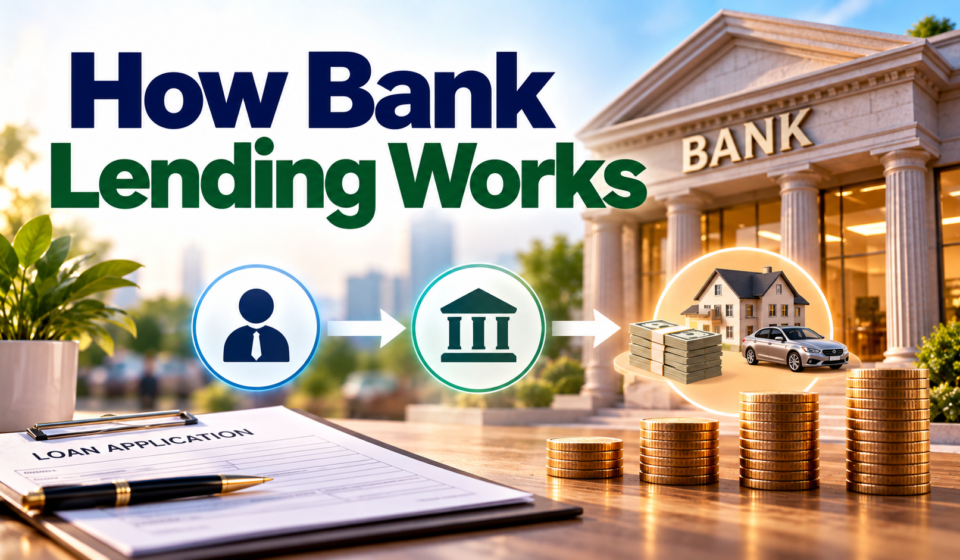

Banks play an important role in the financial system by connecting people and businesses that need money with the broader pool of funds available within the banking system.
Whether someone wants to buy a home, finance a car, expand a business, pay for education, or manage a major expense, borrowing from a bank can provide access to money that may not otherwise be immediately available.
But getting a loan involves much more than simply receiving money from a bank and paying it back later.
Banks evaluate borrowers, determine interest rates, establish repayment terms, manage credit risk, and follow regulatory requirements before and after providing loans.
Understanding how bank lending works can help borrowers make better decisions about debt and understand what happens behind a typical loan application.
What Is Bank Lending?
Bank lending is the process through which a bank provides money to an individual, business, or other eligible borrower with an agreement that the money will be repaid according to specific terms.
The borrower generally agrees to repay:
- The original amount borrowed
- Interest charged by the lender
- Applicable fees or other costs
The original amount borrowed is called the principal.
For example, if a person takes a loan of $20,000, the principal is $20,000. Interest is then calculated according to the loan’s terms.
Different loans have different repayment structures, interest rates, security requirements, and durations.
Where Does the Bank Get the Money to Lend?
Banks operate within a broader financial system.
One important source of bank funding is customer deposits. People and businesses deposit money into bank accounts, and banks use their balance sheets to provide loans and make other investments while maintaining required liquidity and capital.
Banks can also obtain funding through other channels, including borrowing in financial markets and transactions with other financial institutions.
This means bank lending is connected to the wider financial system rather than being a simple process of handing out deposited cash.
The Basic Lending Process
A typical bank lending process can be understood through several stages.
1. The Borrower Applies
The process begins when a customer applies for a loan.
The application may request information such as:
- Identity details
- Income
- Employment
- Existing debts
- Assets
- Purpose of the loan
- Requested loan amount
- Repayment period
The exact requirements depend on the type of loan and the lender.
2. The Bank Reviews the Application
The bank evaluates the information provided by the borrower.
The purpose is to determine whether the borrower appears capable of repaying the loan and whether the proposed lending arrangement fits the bank’s lending criteria.
3. Creditworthiness Is Assessed
The bank may review the borrower’s credit history and other financial information.
Creditworthiness can involve factors such as:
- Previous repayment behavior
- Existing debt
- Income
- Employment stability
- Credit history
- Assets
- Financial obligations
A borrower with a strong repayment history and manageable debt may present a different level of credit risk from someone with a history of missed payments and significant outstanding obligations.
4. The Bank Determines Loan Terms
If the bank decides to approve the application, it establishes the loan terms.
These may include:
- Loan amount
- Interest rate
- Repayment period
- Monthly payment
- Fees
- Collateral requirements
- Other conditions
The borrower should review these terms carefully before accepting the loan.
5. The Loan Is Disbursed
After the required agreements and documentation are completed, the bank provides the funds.
Depending on the loan, the money may be transferred directly to the borrower’s account or paid to another party.
For example, with some vehicle or property purchases, funds may be transferred as part of the purchase transaction.
6. The Borrower Makes Repayments
The borrower then makes payments according to the agreed schedule.
Each payment may include a combination of principal and interest.
Over time, the outstanding principal generally decreases as repayments are made, assuming the borrower remains current and the loan structure does not provide otherwise.
What Banks Look at Before Approving a Loan
Banks need to manage the possibility that a borrower may not repay.
This is known as credit risk.
To manage that risk, lenders examine information about the borrower and the proposed loan.
Income
Income provides information about the borrower’s ability to make regular payments.
The lender may consider salary, business income, investment income, or other eligible sources depending on the loan.
Existing Debt
A borrower who already has substantial monthly debt obligations may have less available income for a new loan.
Banks may therefore examine existing loans, credit card balances, and other financial commitments.
Credit History
Credit history provides information about previous borrowing and repayment behavior.
A history of consistently making payments can provide evidence of responsible credit management.
Employment or Business Stability
For some types of lending, lenders may consider the stability and predictability of income.
Requirements vary depending on the lender and type of borrower.
Collateral
Some loans are secured by an asset.
For example, a mortgage is generally secured against the property being financed.
If the borrower fails to meet the loan obligations, the lender may have legal rights related to the collateral, subject to applicable laws and the loan agreement.
Secured vs Unsecured Loans
One of the simplest ways to understand different forms of bank lending is to distinguish between secured and unsecured loans.
| Feature | Secured Loan | Unsecured Loan |
|---|---|---|
| Collateral | Usually required | Usually not required |
| Lender’s risk | Supported by pledged assets | Primarily based on borrower creditworthiness |
| Common examples | Mortgages, some vehicle loans | Personal loans, many credit cards |
| Interest rate | May be lower depending on risk | May be higher depending on borrower and product |
| Consequence of default | Collateral may be subject to recovery procedures | Lender may pursue other legal collection options |
The exact terms vary by country, lender, and loan product.
How Banks Make Money From Lending
Interest is one of the main ways banks generate revenue from lending.
Suppose a bank provides a loan at an interest rate of 8 percent.
The borrower pays interest according to the loan agreement.
Banks also generate revenue through various fees and other financial activities.
However, lending also creates costs and risks for banks.
A bank must consider:
- Funding costs
- Operating expenses
- Regulatory requirements
- Credit losses
- Liquidity requirements
- Capital requirements
- Market conditions
This is why the interest rate charged to borrowers is not simply the bank’s profit.
How Interest Rates Work
Interest is the cost of borrowing money.
There are several ways interest can be structured.
Fixed Interest Rate
A fixed rate remains unchanged for the specified period covered by the agreement.
This can make repayment amounts more predictable.
Variable Interest Rate
A variable rate can change according to an underlying benchmark, reference rate, or other contractual mechanism.
If the applicable rate rises, the borrower’s payments or total interest costs may increase depending on the loan structure.
If rates fall, borrowing costs may decrease under some variable rate arrangements.
Simple Example
Suppose a borrower takes a loan of $10,000 at an annual interest rate of 6 percent.
The actual interest paid over the life of the loan depends on factors such as the repayment schedule, loan duration, and how interest is calculated.
This is why borrowers should look at the total repayment cost rather than focusing only on the advertised interest rate.
Why Loan Terms Matter
Two loans can have the same interest rate but different total costs because their repayment periods are different.
Consider a borrower who takes a $20,000 loan.
A shorter repayment period may result in higher monthly payments but potentially lower total interest.
A longer repayment period may reduce the monthly payment but increase the amount of interest paid over the life of the loan.
This creates an important tradeoff between monthly affordability and total borrowing cost.
What Is Amortization?
Amortization describes the process of gradually paying down a loan through scheduled payments.
For many installment loans, each payment contains both principal and interest.
At the beginning of some loans, a larger portion of the payment may go toward interest. As the outstanding principal declines, the interest component may decrease.
The exact structure depends on the loan agreement.
An amortization schedule shows how each payment affects the remaining balance.
What Happens When a Borrower Misses Payments?
Failing to make required payments can have several consequences.
Depending on the loan and applicable rules, the borrower may face:
- Late fees
- Additional interest or charges
- Negative credit reporting
- Collection activity
- Legal action
- Loss of collateral in secured lending
The consequences depend on the contract, lender, jurisdiction, and severity of the default.
If a borrower expects difficulty making a payment, contacting the lender early may provide an opportunity to discuss available options before the situation becomes more serious.
Why Banks Sometimes Reject Loan Applications
A loan application can be rejected for many reasons.
For example:
- Insufficient income
- High existing debt
- Poor credit history
- Unstable financial circumstances
- Insufficient collateral
- Loan amount considered too high relative to repayment capacity
- Failure to meet the lender’s eligibility requirements
A rejection does not necessarily mean the applicant has no access to credit anywhere. Different lenders use different criteria and risk models.
However, repeatedly applying for credit without understanding the reason for rejection can create unnecessary inquiries or financial pressure.
How the Economy Affects Bank Lending
Bank lending is closely connected to economic conditions.
When economic conditions are strong, households and businesses may have greater confidence in borrowing and investing.
During periods of economic weakness, lenders may become more cautious because the risk of borrowers experiencing financial difficulties can increase.
Interest rates also matter.
When central banks raise policy rates, banks may face higher funding costs or adjust lending rates. This can influence the cost and demand for borrowing.
When borrowing becomes more expensive, some households and businesses may postpone loans or reduce the amount they borrow.
The Relationship Between Bank Lending and Economic Growth
Bank lending can influence economic activity because businesses and households often use borrowed money to finance purchases and investments.
A business might borrow money to:
- Purchase equipment
- Open a new location
- Hire employees
- Increase inventory
- Develop a new product
A household might borrow to:
- Purchase a home
- Buy a vehicle
- Pay for education
- Cover a major planned expense
When credit is available and borrowers can repay comfortably, lending can support economic activity.
However, excessive borrowing can create problems when debt levels become difficult to manage.
Responsible Borrowing
Borrowing money is not automatically good or bad.
The important question is whether the debt fits the borrower’s financial situation and purpose.
Before accepting a loan, consider:
Can You Afford the Monthly Payment?
Look at the payment alongside your existing expenses and financial obligations.
What Is the Total Cost?
Do not focus only on the monthly payment. Consider interest, fees, and the total amount that will be repaid.
Is the Loan Necessary?
Borrowing for a productive or important financial purpose can be different from borrowing for unnecessary consumption.
What Happens if Your Income Falls?
Consider whether you could continue making payments if your financial circumstances changed.
Is the Interest Rate Fixed or Variable?
Understanding how the rate can change is especially important for longer term borrowing.
Bank Lending and Credit Scores
Credit scores can play a role in the lending process.
A lender may use credit information to assess previous borrowing behavior and estimate the risk associated with providing new credit.
However, a credit score is only one part of a lending decision.
Banks can also consider income, existing debt, employment, collateral, loan purpose, and other information.
The importance of each factor depends on the lender and type of loan.
Final Thoughts
Bank lending is a process through which financial institutions provide money to borrowers under agreed repayment terms.
Behind every loan is a process of evaluating risk, determining appropriate terms, providing funds, and collecting repayments.
For borrowers, understanding this process can make it easier to compare loan offers and recognize the true cost of borrowing.
Interest rates, repayment periods, fees, collateral requirements, credit history, and income can all influence the final terms of a loan.
Bank lending also affects the wider economy. When households and businesses borrow, they can use those funds for purchases, investment, expansion, and other economic activities. At the same time, excessive borrowing can create financial pressure if debt becomes difficult to repay.
A loan should therefore be viewed as a financial commitment rather than simply as access to extra money.
Understanding how the lending process works is the first step toward using credit responsibly and making borrowing decisions based on the complete cost and financial impact.
Frequently Asked Questions
What is bank lending?
Bank lending is the process through which a bank provides money to an individual or organization with an agreement that the borrower will repay the principal, interest, and applicable charges according to specified terms.
How do banks decide whether to approve a loan?
Banks may consider credit history, income, existing debt, employment or business information, collateral, loan purpose, and other factors when evaluating an application.
What is the difference between secured and unsecured loans?
A secured loan generally involves collateral, while an unsecured loan generally does not require a specific asset to be pledged. Unsecured lending relies more heavily on the borrower’s creditworthiness and other financial information.
Why do banks charge interest on loans?
Interest compensates the lender for providing funds and taking on lending risk. The interest rate also reflects funding costs, market conditions, operating costs, and other factors.
What is loan principal?
Principal is the original amount borrowed. As the borrower makes qualifying repayments, the outstanding principal generally decreases.
What is an interest rate?
An interest rate represents the cost of borrowing, usually expressed as a percentage. The actual amount of interest paid depends on the loan balance, rate, repayment schedule, and loan terms.
Can a bank change the interest rate?
It depends on the type of loan. Fixed rate loans generally maintain the agreed rate for the applicable fixed period, while variable rate loans can change according to their contractual terms.
What happens if you cannot repay a bank loan?
Consequences can include late charges, negative credit reporting, collection activity, legal proceedings, or loss of collateral for secured loans. The exact consequences depend on the loan agreement and applicable laws.
Does having a high credit score guarantee loan approval?
No. Credit score is only one factor that lenders may consider. Income, debt obligations, collateral, loan amount, employment, and other information can also influence lending decisions.
Why are loan payments sometimes different for different borrowers?
Loan terms can vary based on factors such as credit history, income, loan amount, repayment period, collateral, lender policies, and prevailing market conditions.
How does bank lending affect the economy?
Bank lending can support household spending, business investment, property purchases, and economic activity. At the same time, excessive debt can create financial risks for borrowers and lenders.
Should you compare loans before borrowing?
Yes. Comparing the interest rate, total repayment amount, fees, repayment period, penalties, and other terms can help borrowers understand the overall cost of a loan before accepting it.