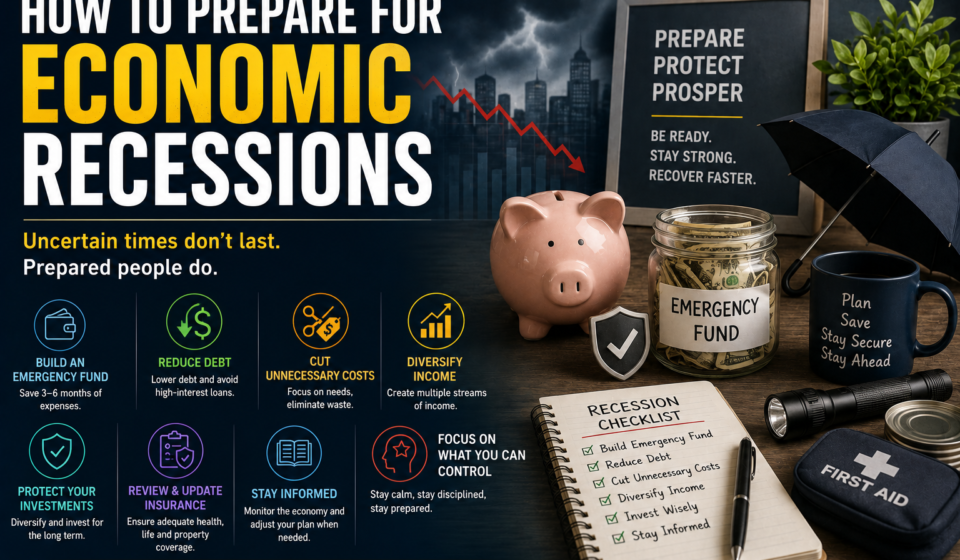

Economic recessions can affect businesses, workers, investors, and households in different ways. During a recession, economic activity may slow, consumer spending can decline, businesses may reduce investment, and unemployment can increase.
No one can predict exactly how severe a future recession will be or how long it will last. However, individuals and businesses can take practical steps to improve their financial resilience.
Preparing for an economic downturn is not about making extreme decisions. It is about understanding your finances, maintaining flexibility, controlling unnecessary expenses, and creating a plan before financial pressure increases.
What Is an Economic Recession?
A recession is a significant decline in economic activity across the economy that lasts for a period of time.
During a recession, businesses may experience lower demand, households may reduce spending, and financial markets can become more volatile.
The effects are not identical for everyone. Some industries may be affected more heavily than others, while certain sectors may continue to grow.
Why Should You Prepare for a Recession?
Economic downturns can create financial uncertainty.
Possible challenges include:
- Lower business revenue
- Reduced working hours
- Job losses
- Falling consumer demand
- Investment market volatility
- Difficulty accessing credit
- Higher financial stress
Preparation can provide more flexibility when circumstances change.
Review Your Current Financial Position
Start by understanding where you stand financially.
Review:
- Monthly income
- Regular expenses
- Debt
- Savings
- Investments
- Insurance
- Emergency funds
- Major financial commitments
A clear financial picture makes it easier to identify areas that need attention.
Build an Emergency Fund
An emergency fund can help cover unexpected expenses or temporary income reductions.
The appropriate amount depends on your circumstances, including job stability, household expenses, dependents, and access to other resources.
Keep emergency savings somewhere accessible and relatively low risk rather than placing all of it in volatile investments.
Calculate Essential Monthly Expenses
Separate essential expenses from discretionary spending.
Essential expenses may include:
- Housing
- Food
- Utilities
- Insurance
- Transportation
- Healthcare
- Minimum debt payments
Knowing your essential monthly expenses helps you estimate how much money you would need if your income temporarily decreased.
Review Your Budget
A recession can be a good reason to examine your spending.
Look for recurring expenses that may not be necessary.
Review:
- Subscriptions
- Dining expenses
- Entertainment
- Shopping
- Travel
- Memberships
- Unused services
The goal is not to eliminate everything enjoyable. It is to understand where your money is going and identify expenses that could be reduced if necessary.
Reduce High Cost Debt
High interest debt can become more difficult to manage when income is under pressure.
Prioritize understanding:
- Interest rates
- Minimum payments
- Outstanding balances
- Repayment schedules
Reducing expensive debt can improve financial flexibility.
Avoid taking on unnecessary new debt simply because economic conditions appear uncertain.
Avoid Overextending Credit
Credit can provide useful financial flexibility, but excessive borrowing can create problems during an economic downturn.
Before taking on new debt, consider whether the payment would remain manageable if your income decreased.
Review Your Employment Situation
Employees can prepare by understanding their current job situation.
Consider:
- Industry stability
- Employer financial health
- Transferable skills
- Professional network
- Alternative employment opportunities
This does not mean assuming that job loss is inevitable. It means being prepared for unexpected changes.
Update Your Resume
Keeping your resume current can make it easier to respond to new opportunities.
Include:
- Recent responsibilities
- New skills
- Certifications
- Major achievements
- Projects
- Relevant experience
It can also be useful to maintain a professional portfolio where appropriate.
Develop Transferable Skills
Skills that can be applied across industries may provide additional flexibility during changing economic conditions.
Examples include:
- Communication
- Data analysis
- Project management
- Technology skills
- Sales
- Financial management
- Customer service
- Problem solving
Continuous learning can improve your ability to adapt.
Maintain Your Professional Network
Professional relationships can become valuable during periods of economic uncertainty.
Stay connected with:
- Former colleagues
- Industry professionals
- Clients
- Mentors
- Business contacts
Networking should not only happen when you need a job. Maintaining genuine professional relationships over time is more effective.
Diversify Your Income Where Appropriate
Depending on your skills and circumstances, additional income sources may provide financial flexibility.
Potential options include:
- Freelance work
- Consulting
- Part time work
- Online services
- Small business activities
- Skill based projects
Additional income should be realistic and should not create unsustainable workload or financial risk.
Review Your Investments
Economic recessions often create volatility in financial markets.
Review your investment portfolio based on your:
- Time horizon
- Financial goals
- Risk tolerance
- Income needs
- Diversification
Avoid making major investment decisions based solely on fear or short term market movements.
Maintain Diversification
Diversification means spreading investments across different assets, industries, regions, or other categories.
A diversified portfolio can reduce dependence on the performance of one particular investment.
Diversification does not eliminate investment risk.
Understand Your Investment Time Horizon
Someone investing for retirement decades away may have a different strategy from someone who needs the money within a few months.
Before changing investments, consider when the money will be needed.
Short term financial needs generally require a different approach from long term investment goals.
Avoid Panic Selling
Market declines can be emotionally difficult.
Selling investments during a market decline may turn temporary losses into realized losses and can make it harder to participate if markets recover.
Investment decisions should be based on your financial plan rather than short term fear whenever possible.
Review Your Retirement Plan
A recession may affect retirement accounts and investment portfolios.
However, long term retirement planning should consider many years rather than a single economic cycle.
Review contributions, asset allocation, fees, and retirement goals periodically.
Review Insurance Coverage
Insurance can protect against certain financial risks.
Depending on your situation, review:
- Health insurance
- Life insurance
- Disability coverage
- Home insurance
- Auto insurance
- Business insurance
Make sure you understand what is covered and what is excluded.
Prepare Your Household Budget
Families can improve financial resilience by creating a realistic household budget.
Divide spending into:
Essential Expenses
Costs required for basic living and financial obligations.
Flexible Expenses
Costs that can potentially be reduced if income falls.
Optional Expenses
Spending that can be postponed during difficult periods.
This structure can make it easier to adjust spending quickly.
Prepare for Large Expenses
Consider upcoming expenses such as:
- Education
- Home repairs
- Vehicle replacement
- Insurance premiums
- Taxes
- Medical expenses
- Major family commitments
Planning ahead can reduce the need for expensive borrowing.
Build a Recession Plan
Create a simple plan before financial pressure appears.
For example:
If Income Falls Slightly
Reduce discretionary spending and review recurring expenses.
If Income Falls Significantly
Use emergency savings, reduce nonessential expenses, and consider additional income opportunities.
If Employment Is Lost
Review available financial resources, update your job search materials, and prioritize essential expenses.
Having predefined steps can reduce uncertainty.
Prepare Your Business for a Recession
Businesses can also improve their resilience.
Start by reviewing:
- Cash flow
- Revenue sources
- Fixed costs
- Variable costs
- Debt
- Customer concentration
- Supplier relationships
- Inventory
Understanding these areas can reveal vulnerabilities.
Maintain Business Cash Reserves
Businesses may experience declining revenue during economic downturns.
Maintaining appropriate cash reserves can help cover operating expenses when customer payments slow.
The appropriate reserve depends on the business model and financial stability.
Control Fixed Costs
Fixed costs can become challenging when revenue falls.
Businesses should periodically review:
- Office costs
- Software
- Equipment
- Staffing
- Insurance
- Financing
- Long term contracts
Avoid making major cost reductions without considering their effect on revenue and operations.
Protect Your Best Customers
Customer retention becomes particularly important during an economic slowdown.
Businesses can focus on:
- Customer service
- Product quality
- Reliability
- Communication
- Value
- Retention programs
Understanding why customers stay can help businesses strengthen their relationships.
Diversify Business Revenue
A company that depends heavily on one customer, product, or market may face greater risk if that source declines.
Where practical, businesses can explore additional:
- Customer segments
- Products
- Services
- Geographic markets
- Sales channels
Diversification should be strategic rather than rushed.
Review Business Debt
Businesses should understand their borrowing obligations.
Review:
- Interest rates
- Payment schedules
- Loan maturity dates
- Outstanding balances
- Variable rate exposure
Avoid taking on unnecessary debt when cash flow is uncertain.
Manage Inventory Carefully
Businesses selling physical products should review inventory levels.
Excess inventory can tie up cash.
Insufficient inventory can cause missed sales.
Use demand forecasts and sales data to make informed inventory decisions.
Maintain Strong Supplier Relationships
Economic downturns can affect supply chains and supplier pricing.
Maintaining good relationships with suppliers can provide greater flexibility during difficult periods.
Businesses may also consider having alternative suppliers for critical products.
Monitor Economic Indicators
You do not need to follow every economic statistic.
Useful indicators can include:
- Unemployment
- Inflation
- Interest rates
- Consumer spending
- Business investment
- Economic growth
- Housing activity
Understanding broad trends can help households and businesses think about financial planning.
Do Not Base Decisions on Headlines Alone
Economic news can change quickly.
A single headline does not necessarily describe the overall economic situation.
Use multiple reliable sources and focus on information relevant to your own financial circumstances.
Keep Important Documents Organized
Financial documents should be easy to access when needed.
Organize:
- Bank information
- Investment statements
- Insurance policies
- Tax documents
- Loan agreements
- Employment records
- Business records
Good organization can reduce stress during unexpected financial changes.
Protect Against Scams
Economic uncertainty can increase the appeal of promises involving quick profits, guaranteed returns, or emergency financial assistance.
Be cautious with:
- Unsolicited investment offers
- Guaranteed profit claims
- Pressure to send money quickly
- Requests for sensitive information
- Unverified financial opportunities
Verify information before making financial decisions.
Avoid Extreme Financial Decisions
Preparing for a recession does not necessarily mean selling all investments, stopping every form of spending, or keeping all money in cash.
Extreme decisions can create new financial risks.
A balanced approach usually focuses on:
- Liquidity
- Diversification
- Debt management
- Cost control
- Income stability
- Long term planning
Recession Preparation Checklist
A practical checklist can include:
- Review your financial position.
- Calculate essential expenses.
- Build emergency savings.
- Reduce high interest debt.
- Review insurance.
- Update your resume.
- Develop transferable skills.
- Maintain professional relationships.
- Review your investment strategy.
- Diversify where appropriate.
- Prepare for major expenses.
- Create a backup income plan.
- Review business cash flow if you own a company.
- Control unnecessary expenses.
- Avoid panic driven decisions.
Final Thoughts
Preparing for an economic recession is mainly about building financial flexibility before you need it.
For individuals, this can mean maintaining emergency savings, controlling debt, reviewing expenses, strengthening skills, and maintaining a sensible investment strategy.
For businesses, preparation can involve managing cash flow, controlling fixed costs, protecting customer relationships, reviewing debt, and diversifying revenue.
No strategy can completely eliminate the effects of an economic downturn. However, being financially organized can make it easier to respond to changing conditions.
The best time to prepare is generally before financial pressure becomes severe. A clear plan can give households and businesses more options when the economy becomes uncertain.
Frequently Asked Questions
What is an economic recession?
An economic recession is a significant decline in economic activity across an economy that lasts for a period of time.
How can I prepare financially for a recession?
Build emergency savings, manage debt, review expenses, maintain appropriate insurance, protect income, and keep your financial plan aligned with your long term goals.
How much emergency savings should I have?
There is no single amount that works for everyone. Consider your essential expenses, income stability, dependents, debt, and access to other financial resources.
Should I sell my investments before a recession?
Not necessarily. Investment decisions should be based on your financial goals, time horizon, risk tolerance, and overall plan rather than predictions about short term economic conditions.
Is cash important during a recession?
Accessible cash can provide flexibility for unexpected expenses or temporary income reductions. The appropriate amount depends on your financial situation.
Should I pay off debt before a recession?
Reducing high cost debt can improve financial flexibility, but decisions should also consider emergency savings and other financial priorities.
How can businesses prepare for a recession?
Businesses can review cash flow, reduce unnecessary expenses, maintain appropriate reserves, manage debt, protect customers, and prepare alternative revenue strategies.
Should businesses stop spending during a recession?
Not necessarily. Businesses should distinguish between unnecessary costs and investments that support essential operations or long term growth.
Can a recession affect investments?
Yes. Economic downturns can affect company earnings, financial markets, interest rates, employment, and investor confidence.
What industries are affected most during recessions?
The impact varies by recession, but industries that depend heavily on discretionary consumer spending or economic expansion may experience greater pressure.
Can some businesses grow during a recession?
Yes. Some businesses may benefit from changing consumer needs, cost conscious customers, or increased demand for specific products and services.
Should I take on new debt before a recession?
New debt should be evaluated carefully. Consider the interest rate, repayment obligations, expected benefit, and ability to make payments if income falls.
How can I protect my job during a recession?
Continue developing useful skills, maintain strong performance, stay adaptable, build professional relationships, and keep your resume updated.
Is a side income useful during economic uncertainty?
An additional income source may provide flexibility, but it should be realistic and should not create excessive financial or personal strain.
What skills are valuable during economic downturns?
Transferable skills such as communication, technology, data analysis, project management, sales, financial management, and problem solving can be useful across different industries.
Should I stop investing during a recession?
Not automatically. Investment decisions depend on your goals, time horizon, risk tolerance, and financial situation.
Why is diversification important?
Diversification reduces dependence on a single investment, industry, market, or income source. It cannot eliminate risk but can help manage concentration risk.
What economic indicators should I watch?
Unemployment, inflation, interest rates, consumer spending, business investment, and economic growth can provide useful information about economic conditions.
How can I reduce household expenses?
Review subscriptions, discretionary purchases, dining, entertainment, travel, and other flexible expenses while protecting essential needs.
How can small businesses manage cash flow during a recession?
Businesses can invoice promptly, monitor receivables, control expenses, maintain cash reserves, manage inventory, and review payment terms.
What is recession proofing?
Recession proofing refers to steps individuals or businesses take to improve their ability to withstand economic downturns.
Can a recession affect employment?
Yes. Some companies may reduce hiring, working hours, or staff during periods of weaker economic activity.
Should I change my career during a recession?
Career decisions should be based on your skills, opportunities, financial position, and long term goals rather than economic headlines alone.
How can I prepare my family for a recession?
Create a household budget, build emergency savings, manage debt, review insurance, and discuss practical financial priorities with family members.
What is the biggest recession preparation mistake?
Waiting until financial problems become severe can reduce available options. Preparing early generally provides more flexibility.
Can financial planning eliminate recession risk?
No. Financial planning cannot eliminate economic risk, but it can improve resilience and help individuals and businesses respond more effectively.
When should I start preparing for a recession?
You do not need to wait for an official recession announcement. Building savings, managing debt, controlling expenses, and maintaining financial flexibility are useful at any stage of the economic cycle.