
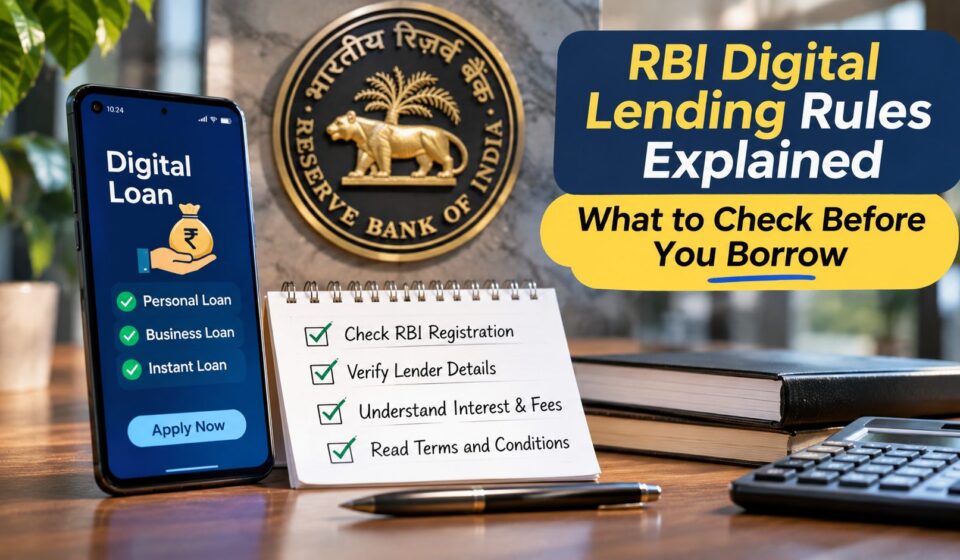

Getting a loan through a mobile application has become increasingly convenient. A borrower can compare offers, submit documents, complete identity verification and receive a lending decision without visiting a bank branch.
However, convenience does not always mean that a loan is affordable or that the lending platform operates responsibly.
Digital lending has introduced concerns involving hidden charges, unauthorised loan applications, misleading advertisements, excessive data collection and aggressive recovery practices. Some borrowers have also struggled to identify the actual lender behind an application. To address these issues, the Reserve Bank of India has introduced and strengthened regulatory requirements governing digital lending activities. These requirements are designed to improve transparency, establish accountability and protect borrowers when loans are distributed through digital channels. For anyone considering an online personal loan, understanding these rules can help prevent costly mistakes.
This guide explains the important RBI digital lending requirements, how they affect borrowers and what should be checked before accepting a digital loan in India.
Why Did RBI Introduce Digital Lending Regulations?
Digital lending has expanded because smartphones and online financial services have made borrowing more accessible.
Banks and Non Banking Financial Companies (NBFCs) increasingly use digital platforms to reach customers, assess applications and distribute loans.
However, the rapid growth of this business model also created opportunities for irresponsible operators.
Some applications advertised instant loans without clearly explaining the lender’s identity, interest rates or repayment conditions.
In other cases, borrowers faced unexpected deductions, excessive processing charges or inappropriate recovery practices.
The RBI’s regulatory response aims to ensure that digital lending remains connected to accountable and regulated financial institutions.
The central principle is straightforward: using technology to distribute a loan does not remove the lender’s responsibility to follow applicable financial regulations.
Who Is Responsible When You Borrow Through a Loan App?
This is one of the most important details borrowers should understand.
A digital lending application may not be the actual institution providing the loan.
In many arrangements, a bank or NBFC works with a Lending Service Provider (LSP) to perform activities such as customer acquisition, application processing, technology support or loan servicing.
The regulated lender remains responsible for ensuring that applicable regulatory requirements are followed.
Understanding the three main participants
1. Regulated Entity
A Regulated Entity (RE) is the bank or NBFC that provides the regulated lending service.
It is responsible for the loan and must maintain appropriate oversight of the digital lending activities undertaken on its behalf.
2. Lending Service Provider
An LSP is an agent of a regulated entity that performs specified lending related functions.
It may provide technology, customer support, application processing or other services under an arrangement with the lender.
3. Borrower
The borrower is the person receiving the loan and agreeing to its repayment conditions.
Borrowers should identify the actual regulated lender before accepting an offer.
A familiar application name or attractive advertisement does not establish that the platform itself is authorised to provide loans.
RBI Digital Lending Rules: The Important Requirements
The RBI’s digital lending framework includes several requirements that directly affect the borrowing experience.
Understanding these provisions can help borrowers evaluate whether a digital loan is being offered transparently.
1. Clear Disclosure of the Actual Lender
A digital lending platform should clearly identify the regulated entity responsible for the loan.
Borrowers should not have to guess whether the loan is being provided by a bank, an NBFC or another institution.
Before proceeding, check:
- The legal name of the lending institution.
- Whether it is a bank or NBFC.
- The relationship between the application and the lender.
- The contact details for customer complaints.
- The institution responsible for servicing the loan.
If the application refuses to identify the actual lender, treat this as a warning sign.
2. Key Fact Statement Before Loan Acceptance
One of the most useful borrower protections is the Key Fact Statement (KFS).
For applicable retail and microfinance term loans, RBI requirements provide for a standardised KFS containing important information about the loan.
It helps borrowers understand the actual cost instead of relying on an attractive advertised interest rate.
A KFS generally includes relevant details such as:
- Loan amount.
- Annual Percentage Rate (APR).
- Repayment schedule.
- Applicable fees and charges.
- Penal charges, where applicable.
- Other material loan conditions.
The KFS should be provided before the borrower enters into the loan contract.
Borrowers should read it carefully rather than accepting the offer immediately.
3. Understanding the Annual Percentage Rate
The interest rate advertised by a lending application may not represent the complete cost of borrowing.
A loan may include processing charges and other applicable expenses.
The Annual Percentage Rate provides a broader view of the cost of credit by accounting for relevant interest and charges in accordance with the applicable methodology.
Consider this hypothetical example:
A borrower receives an offer for a ₹1,00,000 personal loan at an advertised annual interest rate of 14%.
The lender also charges a processing fee and applicable taxes.
The total borrowing cost will therefore be higher than the interest rate alone suggests.
This is why comparing APR is generally more useful than comparing only advertised interest rates.
Borrowers should also examine the repayment schedule and the total amount payable over the entire loan period.
4. Direct Disbursement Into the Borrower’s Bank Account
RBI’s digital lending requirements generally provide that loan disbursement should take place directly between the regulated lender and the borrower’s bank account, subject to specified exceptions.
This helps reduce the risk of unauthorised intermediaries handling loan proceeds.
For ordinary digital loans, borrowers should be cautious if an application asks them to receive the money through an unrelated personal account or an unknown third party.
Certain permitted arrangements, such as specific end use payments, have their own regulatory treatment.
The important point is that money movement should follow the applicable lending framework and clearly documented arrangements.
5. Repayment Should Go Directly to the Regulated Lender
Loan repayments should generally be made directly into the bank account of the regulated lender rather than through an unrelated third party’s personal account.
This helps borrowers maintain a clearer repayment record.
Before making payments, confirm:
- The authorised repayment account.
- The lender’s official payment instructions.
- The loan account reference.
- The payment confirmation process.
- How repayments are reflected in the loan statement.
Never transfer money to an unknown individual claiming to represent a loan recovery department.
6. Restrictions on Unauthorised Fees
Borrowers should understand which charges are payable and who is authorised to collect them.
Under RBI’s digital lending framework, fees payable to an LSP by the regulated entity must generally be paid by the regulated entity rather than separately collected from the borrower.
Permitted loan charges and their treatment should be transparently disclosed in the applicable loan documentation and KFS.
A borrower should question unexpected demands for separate payments that were not disclosed during the loan application.
7. Cooling Off or Look Up Period
Digital lending regulations provide for a cooling off period during which borrowers can exit an eligible digital loan by paying the principal and proportionate APR without a penalty for that exit, subject to applicable conditions.
The regulated entity determines the cooling off period, subject to the minimum prescribed by RBI.
For covered digital loans, the period must be at least one day.
The lender may retain a reasonable one time processing fee if it was disclosed upfront in the KFS.
This provision gives borrowers an opportunity to reconsider a loan shortly after accepting it.
However, it should not be confused with a general right to cancel any loan at any time without consequences.
Borrowers should check the exact cooling off conditions in the loan agreement.
8. Responsible Collection of Personal Data
A loan application may request personal information to verify identity and assess creditworthiness.
However, borrowers should understand why their information is being collected.
RBI’s digital lending framework includes requirements relating to data collection, consent and the use of information.
Digital lending applications should collect only the information necessary for the relevant lending activity and should follow applicable privacy and security requirements.
Certain access to mobile phone resources is restricted. For example, the framework places restrictions on access to mobile phone resources such as contact lists, call logs and telephony functions.
Camera, microphone and location access may be requested for specific onboarding or KYC purposes with explicit borrower consent, where permitted.
Borrowers should be suspicious of applications demanding unnecessary access to their contacts, photographs or other private information.
9. Clear Complaint Redressal Mechanism
Borrowers should have a way to report problems involving loan servicing, charges, data handling or recovery practices.
The regulated lender must provide appropriate grievance redressal arrangements for digital lending activities.
Borrowers should be able to identify the responsible grievance officer and the process for submitting complaints.
If a complaint is not resolved satisfactorily within the applicable period, the borrower may be eligible to approach the RBI’s Complaint Management System or Integrated Ombudsman Scheme, subject to the relevant eligibility requirements.
Keeping loan agreements, payment receipts and communication records can help when raising a complaint.
What Is a Digital Lending App’s Responsibility?
A digital lending application should not be treated as a platform that can operate without accountability simply because it is technically an intermediary.
Where an application acts as an LSP, it performs functions on behalf of the regulated entity.
Its responsibilities depend on the contractual arrangement and applicable regulatory requirements.
These may include:
Transparent loan information: Providing access to relevant loan terms and disclosures.
Accurate lender identification: Clearly identifying the bank or NBFC responsible for the loan.
Responsible data practices: Following applicable consent, privacy and security requirements.
Customer support: Directing borrowers towards the appropriate grievance mechanism.
Fair communication: Avoiding misleading representations about loan approval, interest rates or repayment obligations.
Borrowers should remember that the actual regulated lender remains accountable for the lending activities carried out through its LSPs.
How to Identify a Potentially Unauthorised Loan Application
Not every application offering instant loans is trustworthy.
Some warning signs should prompt borrowers to stop and investigate before sharing personal information.
| Warning sign | Why it matters |
|---|---|
| No clear lender name | The actual financial institution cannot be identified |
| Unexplained upfront payments | The application may be attempting to collect unauthorised charges |
| No loan agreement | Important contractual terms may be missing |
| Excessive mobile permissions | Personal information may be collected unnecessarily |
| Threatening recovery messages | Collection practices may be inappropriate |
| No grievance contact | Borrowers may struggle to raise complaints |
| Unrealistic approval promises | Advertisements may be misleading |
| Repayment to personal accounts | Payment arrangements may not follow the expected lending process |
These indicators do not independently establish a regulatory violation in every situation, but they justify additional verification.
What Should You Check Before Accepting an Online Loan?
Consider a borrower who needs ₹2 lakh for a medical expense, home repair or urgent family requirement.
Several applications may offer apparently similar loan amounts.
Choosing the first approval can be expensive.
A better approach is to evaluate each offer systematically.
Check the lender’s identity
Find the actual bank or NBFC providing the loan.
Do not rely solely on the application name.
Compare the APR
Examine the complete annual borrowing cost, including applicable charges.
A lower advertised interest rate may not always result in a cheaper loan.
Calculate the total repayment
Check the amount payable across all instalments.
A small monthly EMI may appear affordable while extending the repayment period and increasing total interest costs.
Review processing fees and penalties
Understand whether processing charges, late payment charges, foreclosure charges or other applicable expenses exist.
Do not assume that all digital loans have identical fee structures.
Examine the repayment schedule
Check the EMI amount, due dates, repayment duration and consequences of missed instalments.
Read the privacy conditions
Understand what information the application collects, why it is needed and how it is handled.
Save the loan documentation
Download the KFS, loan agreement and repayment schedule.
Keep copies of payment receipts and important communications.
A Practical Example: Comparing Two Digital Loan Offers
Suppose an individual needs ₹1,50,000 and receives two offers.
| Loan detail | Offer A | Offer B |
|---|---|---|
| Loan amount | ₹1,50,000 | ₹1,50,000 |
| Advertised annual interest | 13% | 11.5% |
| Processing fee | 2% | 3% |
| Repayment period | 24 months | 24 months |
| Actual APR | Check KFS | Check KFS |
At first glance, Offer B appears more attractive because its advertised interest rate is lower.
However, its processing fee is higher.
The borrower should compare the disclosed APR, total repayment obligation and other charges before deciding.
The example demonstrates why a lower advertised interest rate does not necessarily mean a cheaper loan.
The actual cost must be evaluated using the lender’s official disclosures.
What Happens If You Miss a Digital Loan EMI?
Missing an EMI can have financial consequences.
Depending on the loan agreement and applicable regulations, the borrower may face penal charges, collection communication and an impact on their credit history.
RBI has issued requirements concerning the treatment of penal charges. Regulated entities should not capitalise penal charges by adding them to the interest rate, and penal charges should not be treated as penal interest.
Borrowers should understand the applicable charges before accepting the loan.
If repayment becomes difficult, contacting the lender early is generally better than ignoring reminders.
Keep records of any repayment arrangement agreed upon with the institution.
Borrowers should also be alert to fraudulent recovery messages or individuals demanding payment into unrelated accounts.
What Are the Consequences of Violating RBI Digital Lending Requirements?
Banks and NBFCs operating under RBI’s regulatory framework are expected to comply with applicable digital lending requirements.
Non compliance can lead to supervisory action and other regulatory consequences depending on the nature and seriousness of the issue.
Regulatory oversight is important because digital lending involves sensitive information, financial commitments and direct interactions with customers.
The rules are intended to ensure that technological convenience does not weaken basic lending standards.
However, borrowers should not assume that the existence of RBI regulations means every digital lending application is automatically safe.
Individual verification remains essential.
The Future of Digital Lending in India
Digital lending is likely to remain an important part of India’s financial services landscape.
Automated credit assessment, digital identity verification, alternative data analysis and improved financial infrastructure may make borrowing more efficient.
At the same time, responsible lending will become increasingly important as more consumers use mobile applications to access credit.
Regulatory expectations will continue to focus on transparency, customer consent, fair practices, accountability and data protection.
For borrowers, the most valuable development is not simply faster loan approval. It is the ability to access credit with a clear understanding of the lender, the total cost and the repayment obligations.
Conclusion
RBI’s digital lending requirements are designed to make online borrowing more transparent and accountable.
They address important aspects of the lending process, including lender identification, loan disclosures, fund transfers, data collection, customer complaints and cooling off arrangements.
For borrowers, the practical lesson is to look beyond an application’s promise of instant approval.
Before accepting a loan, identify the regulated lender, read the Key Fact Statement, compare APR, understand all charges and examine the repayment conditions.
A convenient loan can still become a financial burden if its cost and terms are not understood.
Responsible borrowing begins with informed decision making, and understanding the RBI digital lending framework is an important part of that process.
Frequently Asked Questions
1. What are RBI digital lending rules?
RBI digital lending rules are regulatory requirements governing lending activities conducted through digital platforms. They cover matters such as lender accountability, loan disclosures, data collection, fund transfers and grievance redressal.
2. Are all digital loan applications approved by RBI?
No. The presence of an application on a mobile app store does not establish RBI approval. Borrowers should identify the actual regulated bank or NBFC providing the loan and verify the institution’s regulatory status.
3. What is a Key Fact Statement in digital lending?
A Key Fact Statement is a standardised document containing important information about an eligible loan, including the APR, charges and repayment details. It helps borrowers understand the cost of borrowing before accepting the loan.
4. What is APR in a digital loan?
Annual Percentage Rate represents the annualised cost of borrowing, calculated according to the applicable methodology and including relevant interest and charges. It provides a broader cost comparison than the advertised interest rate alone.
5. Can a loan application access my phone contacts?
RBI’s digital lending framework restricts access to mobile phone resources such as contact lists and call logs. Borrowers should be cautious about applications requesting unnecessary personal information or permissions.
6. Can a digital lender charge processing fees?
Permitted charges may apply depending on the loan and applicable rules. Relevant charges should be transparently disclosed in the loan documentation and KFS. LSP fees payable by the regulated entity should not be separately collected from the borrower.
7. What is the cooling off period in digital lending?
It is a period during which a borrower can exit an eligible digital loan by paying the principal and proportionate APR without an exit penalty, subject to applicable conditions. RBI’s framework requires a minimum cooling off period of one day for covered digital loans.
8. Can digital loan repayments be made to a personal bank account?
Generally, digital loan repayments should be made directly to the regulated lender’s bank account. Borrowers should avoid transferring money to unrelated personal accounts unless a properly verified and permitted arrangement applies.
9. What should I do if a digital loan application threatens me?
Save messages and other evidence, contact the regulated lender through its official grievance channel and report suspected harassment or fraud to the appropriate authorities. Do not make payments to unknown individuals.
10. Where can I complain about a digital lending company?
Start by contacting the regulated lender’s grievance redressal officer. If the complaint remains unresolved within the applicable period, you may be eligible to approach the RBI’s Complaint Management System or Integrated Ombudsman Scheme.
11. Does RBI regulate Lending Service Providers?
LSPs operate as agents of regulated entities. The regulated lender is responsible for ensuring that the applicable RBI requirements are followed in activities carried out through its LSPs.
12. Is online borrowing safer after RBI introduced digital lending rules?
The regulatory framework strengthens borrower protections and accountability. However, it does not eliminate all risks. Borrowers must still verify lenders, review loan terms and protect their personal information.
