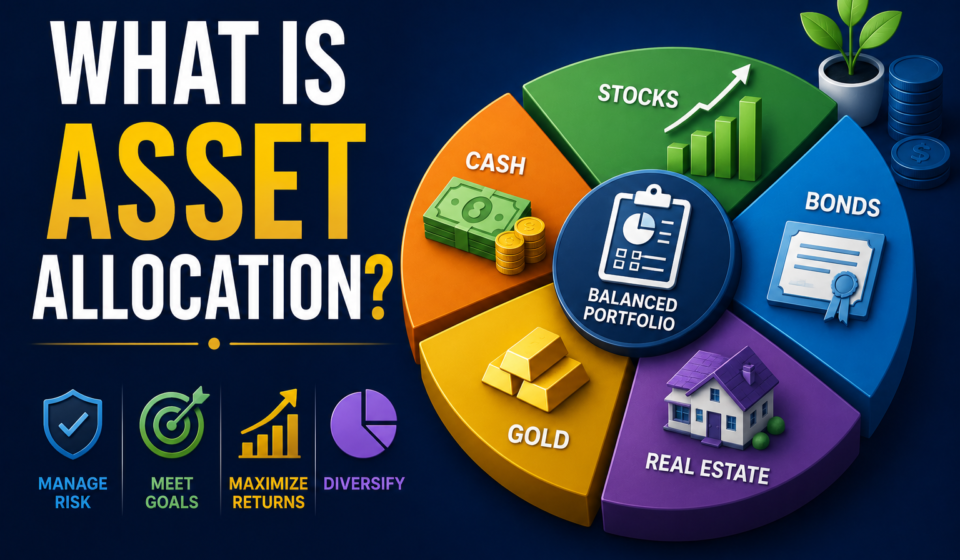

Asset allocation is one of the most important concepts in investing and long-term financial planning. While many investors focus on choosing the “best” stocks or predicting market trends, experienced investors understand that how you divide your investments across different asset classes can have a significant impact on both returns and risk.
No investment performs well in every market condition. Stocks may generate strong returns during periods of economic growth, while bonds or cash may provide greater stability during market downturns. By spreading investments across multiple asset types, investors can build portfolios that are better prepared to withstand changing market conditions.
Whether you’re investing for retirement, buying a home, funding education, or building long-term wealth, understanding asset allocation can help you create a balanced investment strategy that aligns with your financial goals and risk tolerance.
What Is Asset Allocation?
Asset allocation is the process of dividing your investment portfolio among different types of assets to balance potential returns and investment risk.
Rather than investing all your money in a single investment, asset allocation spreads your portfolio across multiple asset classes that often perform differently under various economic conditions.
The primary goal is to reduce overall portfolio risk while supporting long-term financial growth.
Why Is Asset Allocation Important?
Markets are constantly changing. Economic conditions, inflation, interest rates, and global events can affect investments differently.
Asset allocation helps investors:
- Reduce overall investment risk
- Improve portfolio diversification
- Manage market volatility
- Support long-term financial goals
- Protect against large losses
- Maintain consistent investment discipline
- Increase portfolio stability
A well-diversified portfolio is generally better positioned to handle market fluctuations than one concentrated in a single investment.
Main Asset Classes
Most investment portfolios include a combination of the following asset classes.
Stocks
Stocks represent ownership in publicly traded companies.
Advantages include:
- Long-term growth potential
- Capital appreciation
- Dividend income
- Liquidity
However, stock prices can fluctuate significantly in the short term.
Bonds
Bonds are loans made to governments, municipalities, or corporations.
Benefits include:
- More stable returns
- Regular interest income
- Lower volatility than stocks
- Portfolio diversification
Although bonds generally carry lower risk than stocks, they are not risk-free.
Cash and Cash Equivalents
Cash investments include:
- Savings accounts
- Money market accounts
- Short-term deposits
- Treasury bills
Cash provides liquidity and stability but usually generates lower long-term returns compared to stocks.
Real Estate
Real estate investments may include:
- Residential property
- Commercial property
- Real Estate Investment Trusts (REITs)
Real estate can provide rental income, long-term appreciation, and diversification.
Alternative Investments
Some investors also allocate money to alternative assets such as:
- Commodities
- Precious metals
- Infrastructure funds
- Private equity
- Hedge funds
- Collectibles
These investments can provide additional diversification but often involve higher complexity and varying levels of risk.
How Asset Allocation Works
Different assets often respond differently to economic conditions.
For example:
- Stocks may perform well during economic expansion.
- Bonds may provide stability during periods of market uncertainty.
- Cash offers liquidity during volatile markets.
- Real estate may generate rental income and long-term appreciation.
By combining different investments, overall portfolio performance may become more balanced over time.
Factors That Influence Asset Allocation
There is no single asset allocation suitable for everyone.
Important factors include:
Financial Goals
Investment objectives influence portfolio design.
Examples include:
- Retirement planning
- Wealth accumulation
- Education funding
- Home purchase
- Passive income
Risk Tolerance
Some investors are comfortable with higher market volatility, while others prefer more stable investments.
Risk tolerance affects how much exposure an investor may choose to allocate to growth-oriented assets.
Investment Time Horizon
Longer investment horizons often allow investors to tolerate greater short-term fluctuations.
Investors nearing retirement may choose more conservative allocations than younger investors with decades before needing their funds.
Income Needs
Investors seeking regular income may allocate more toward dividend-paying investments, bonds, or income-generating real estate.
Market Conditions
Although long-term strategies should not constantly change based on short-term market movements, investors may periodically review allocations to ensure they remain aligned with their goals.
Example Asset Allocation Models
Asset allocation varies depending on individual circumstances.
A conservative portfolio may emphasize:
- Bonds
- Cash
- Dividend-paying investments
A balanced portfolio may combine:
- Stocks
- Bonds
- Real estate
- Cash
A growth-oriented portfolio may allocate a larger percentage to stocks while maintaining diversification across industries and regions.
These examples are illustrative only and should not be considered personalized investment advice.
Benefits of Diversification
Diversification is closely connected to asset allocation.
Benefits include:
- Reduced concentration risk
- Improved portfolio stability
- Lower impact from individual investment losses
- Better long-term risk management
- Exposure to multiple economic sectors
Diversification cannot eliminate investment risk, but it can help reduce the impact of poor performance from any single investment.
Portfolio Rebalancing
Over time, investment values change.
For example, if stocks perform exceptionally well, they may represent a larger portion of the portfolio than originally intended.
Rebalancing involves periodically adjusting investments to restore the desired asset allocation.
Benefits include:
- Maintaining target risk levels
- Preventing overexposure to one asset class
- Supporting disciplined investing
- Aligning the portfolio with long-term goals
Many investors review their portfolios annually or after significant market movements.
Common Asset Allocation Mistakes
Investors often make avoidable mistakes.
Common examples include:
- Investing everything in one asset class
- Ignoring diversification
- Chasing recent market performance
- Making emotional investment decisions
- Failing to rebalance
- Taking more risk than necessary
- Holding excessive cash for long periods
- Neglecting long-term financial goals
Avoiding these mistakes can improve portfolio resilience.
Asset Allocation vs Diversification
Although closely related, these concepts are different.
Asset allocation refers to how investments are divided among different asset classes.
Diversification refers to spreading investments within each asset class.
For example:
A portfolio allocated to stocks may still diversify by investing across:
- Technology
- Healthcare
- Consumer goods
- Financial services
- Industrial companies
- International markets
Both strategies work together to help manage investment risk.
The Role of Technology
Technology has made portfolio management more accessible.
Modern investment platforms offer:
- Automated portfolio management
- AI-assisted investment analysis
- Portfolio tracking
- Risk assessment
- Rebalancing tools
- Retirement planning calculators
These tools help investors monitor and manage their portfolios more efficiently.
Is Asset Allocation a One-Time Decision?
No.
Asset allocation should evolve as your life circumstances change.
Reasons to review your portfolio include:
- Marriage
- Career changes
- Birth of children
- Retirement planning
- Major financial goals
- Changes in income
- Significant market events
Regular reviews help ensure your investments remain aligned with your objectives.
Final Thoughts
Asset allocation is one of the most effective ways to manage investment risk while pursuing long-term financial growth. Instead of relying on a single investment or attempting to predict market movements, a diversified portfolio spreads investments across multiple asset classes that can perform differently under varying economic conditions.
A well-planned asset allocation strategy should reflect your financial goals, risk tolerance, investment timeline, and income needs. As your circumstances evolve, reviewing and rebalancing your portfolio can help maintain the appropriate balance between growth opportunities and risk management.
While no investment strategy can eliminate risk entirely, thoughtful asset allocation remains a cornerstone of successful long-term investing.
Frequently Asked Questions (FAQs)
1. What is asset allocation?
Asset allocation is the process of dividing an investment portfolio among different asset classes, such as stocks, bonds, cash, and real estate, to balance risk and potential returns.
2. Why is asset allocation important?
Asset allocation helps reduce overall portfolio risk, improve diversification, manage market volatility, and support long-term financial goals.
3. What are the main asset classes?
The primary asset classes include stocks, bonds, cash and cash equivalents, real estate, and alternative investments such as commodities or private equity.
4. Is asset allocation the same as diversification?
No. Asset allocation determines how your investments are distributed among different asset classes, while diversification spreads investments within each asset class to reduce concentration risk.
5. How often should I rebalance my portfolio?
Many investors review and rebalance their portfolios once or twice a year or after major market movements to maintain their intended asset allocation.
6. Can asset allocation eliminate investment risk?
No. Asset allocation cannot eliminate risk, but it can help reduce the impact of market fluctuations by spreading investments across different asset classes.
7. Does asset allocation change with age?
Yes. Many investors gradually shift toward more conservative portfolios as they approach retirement, though the appropriate allocation depends on individual financial goals and risk tolerance.
8. Why shouldn’t I invest everything in stocks?
While stocks offer strong long-term growth potential, concentrating all investments in one asset class increases risk. A diversified portfolio may provide greater stability during market downturns.
9. Can technology help manage asset allocation?
Yes. Many investment platforms provide automated portfolio management, risk analysis, performance tracking, and rebalancing tools to help investors maintain their desired asset allocation.
10. What is the biggest mistake investors make with asset allocation?
One of the most common mistakes is failing to diversify and allowing emotions or short-term market movements to drive investment decisions instead of following a disciplined long-term strategy.