
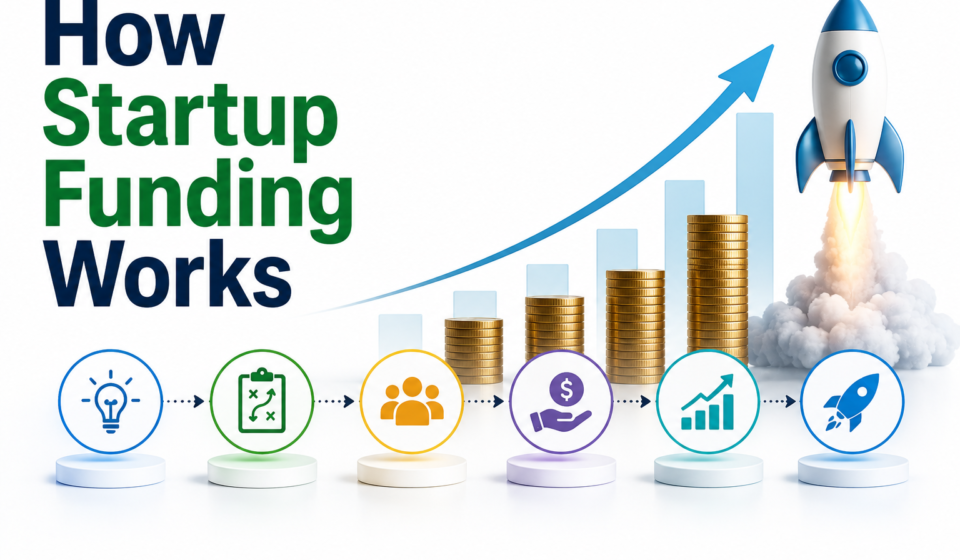

Starting a business often requires more than a great idea and entrepreneurial passion. Most startups need capital to develop products, hire employees, market their services, expand operations, and compete in the marketplace. Startup funding provides the financial resources that enable entrepreneurs to transform innovative ideas into successful businesses.
The startup funding ecosystem has evolved significantly over the past few decades, creating numerous financing options for entrepreneurs at different stages of business growth. From personal savings and family investments to venture capital and public offerings, startups today have access to a wide range of funding sources.
Understanding how startup funding works is essential for entrepreneurs, investors, business professionals, and anyone interested in innovation and business development. Each funding stage has unique characteristics, advantages, challenges, and expectations. Successfully navigating the funding process requires strategic planning, financial discipline, and a clear understanding of investor priorities.
This guide explains how startup funding works, the various funding stages, common financing sources, investor expectations, and the factors that influence startup investment decisions.
What Is Startup Funding?
Startup funding refers to the process of raising financial capital to launch, operate, and grow a new business.
Unlike established companies that may generate sufficient revenue to support operations, startups often require external funding because they are developing products, building customer bases, and expanding their businesses.
Startup funding provides resources for research, product development, hiring employees, marketing, operations, technology infrastructure, and business expansion.
Investors provide funding in exchange for ownership interests, future repayment, or other financial arrangements depending on the type of financing.
The amount and type of funding a startup requires vary significantly based on industry, business model, growth objectives, and market conditions.
Startup financing plays a critical role in supporting entrepreneurship, innovation, and economic growth.
Why Startups Need Funding
Most startups require capital because building a successful business often involves significant upfront expenses before generating consistent revenue.
Entrepreneurs may need funding to develop products, conduct market research, purchase equipment, build technology platforms, hire employees, secure intellectual property rights, and launch marketing campaigns.
Many businesses operate at a loss during their early stages while focusing on growth and customer acquisition.
External funding allows startups to accelerate development and compete more effectively.
Without adequate financing, even promising businesses may struggle to survive or achieve their full potential.
Access to capital often determines whether innovative ideas can successfully reach the marketplace.
Funding provides entrepreneurs with the resources necessary to transform concepts into sustainable businesses.
The Startup Funding Lifecycle
Startup funding typically occurs through several stages as businesses grow and mature.
Each funding stage reflects different levels of business development, risk, valuation, and investor expectations.
Early-stage financing often focuses on validating ideas and developing products.
Later-stage funding supports expansion, market penetration, operational scaling, and profitability.
The funding journey varies considerably among startups, with some companies raising multiple rounds of financing while others rely primarily on internal cash flow.
Understanding the typical funding lifecycle helps entrepreneurs prepare for the challenges and opportunities associated with business growth.
Successful fundraising often requires long-term planning and strategic execution.
Bootstrapping
Bootstrapping refers to building a startup using personal financial resources rather than external investment.
Many entrepreneurs initially fund their businesses using personal savings, income from employment, or revenue generated by early business operations.
Bootstrapping allows founders to maintain complete ownership and control over their companies.
This approach also encourages financial discipline and efficient resource management.
However, bootstrapping may limit growth opportunities if available capital is insufficient.
Many successful companies began as bootstrapped businesses before seeking external financing.
Entrepreneurs who bootstrap their startups often demonstrate strong commitment and confidence in their business ideas.
Self-funding remains one of the most common methods of launching a new business.
Friends and Family Funding
After personal resources, many entrepreneurs seek financial support from friends and family members.
These investments often provide the initial capital needed to validate business concepts and begin operations.
Friends and family investors may be more willing to accept higher risks due to personal relationships and trust.
The financing terms are often more flexible than those offered by professional investors.
However, combining personal relationships with financial investments can create emotional and financial challenges.
Clear communication, legal agreements, and realistic expectations are essential when accepting funds from family and friends.
Although informal, this funding source plays an important role in many entrepreneurial journeys.
Angel Investors
Angel investors are individuals who provide capital to startups in exchange for ownership interests or other financial arrangements.
These investors often possess substantial personal wealth and may have experience as entrepreneurs, executives, or business professionals.
Angel investors typically support early-stage companies with strong growth potential.
In addition to capital, angel investors may provide mentorship, industry expertise, business connections, and strategic guidance.
Angel investments often bridge the gap between early self-funding and larger institutional investments.
Because startups involve significant risks, angel investors generally seek opportunities with substantial growth potential.
Building relationships with experienced angel investors can provide valuable advantages beyond financial support.
Seed Funding
Seed funding represents one of the earliest stages of professional startup financing.
This stage focuses on helping entrepreneurs develop products, validate business models, conduct market research, and establish initial operations.
Seed funding often comes from angel investors, seed investment funds, business incubators, startup accelerators, or early-stage venture capital firms.
The amount of capital raised during seed rounds varies depending on industry and business requirements.
Investors at this stage often prioritize founder quality, market opportunities, innovation, and growth potential rather than current profitability.
Seed funding helps transform concepts and prototypes into viable businesses capable of attracting additional investment.
Venture Capital Funding
Venture capital represents one of the most recognized forms of startup financing.
Venture capital firms invest in companies with significant growth potential in exchange for equity ownership.
These firms raise capital from institutional investors, pension funds, family offices, corporations, and wealthy individuals.
Venture capital investors typically focus on startups capable of generating substantial returns through rapid growth and eventual exits.
In addition to funding, venture capital firms often provide strategic advice, industry expertise, operational support, and business networks.
Venture capital has played a critical role in the growth of many successful technology and innovation companies worldwide.
However, venture capital financing often requires founders to share ownership and decision-making authority.
Series A Funding
Series A funding typically represents the first major institutional investment round for startups.
At this stage, companies have often demonstrated market demand, developed products, and generated initial customer traction.
Series A funding supports product improvements, team expansion, marketing efforts, and operational growth.
Investors evaluate business models, revenue potential, competitive advantages, market size, and management capabilities.
The objective is to establish a scalable business foundation capable of supporting future growth.
Series A investors generally expect significant expansion opportunities and long-term profitability potential.
Successfully raising Series A funding often represents an important milestone in a startup’s development.
Series B and Later Funding Rounds
As startups grow, they may raise additional rounds of financing.
Series B funding typically supports business expansion, market penetration, customer acquisition, and operational scaling.
Later-stage funding rounds may finance international expansion, acquisitions, research and development, and preparation for public offerings.
At these stages, investors often focus heavily on financial performance, growth metrics, market leadership, and competitive positioning.
Funding amounts generally increase as companies mature and valuations rise.
Later-stage financing allows startups to accelerate growth and strengthen market positions.
Access to additional capital often determines whether companies can successfully scale their operations.
Startup Accelerators and Incubators
Startup accelerators and incubators provide support services and funding opportunities for early-stage businesses.
These organizations often offer mentorship, office space, networking opportunities, educational programs, and seed capital.
Startup accelerators typically operate through structured programs lasting several months.
Participants receive guidance from experienced entrepreneurs, investors, and industry experts.
Incubators may provide longer-term support focused on business development and innovation.
Participation in reputable accelerator programs can improve startup credibility and increase access to investors.
Many successful companies have benefited from accelerator and incubator programs during their early stages.
Crowdfunding
Crowdfunding has emerged as an alternative funding source for entrepreneurs.
Crowdfunding platforms allow startups to raise money from large numbers of individuals through online campaigns.
Different forms of crowdfunding exist, including reward-based, donation-based, debt-based, and equity crowdfunding.
This approach enables entrepreneurs to validate market demand while raising capital.
Crowdfunding campaigns may also generate publicity, customer engagement, and community support.
However, successful crowdfunding requires effective marketing, communication, and campaign management.
Not all businesses are suitable for crowdfunding, but it remains an increasingly important component of the startup funding ecosystem.
Bank Loans and Debt Financing
Some startups obtain financing through loans and debt instruments.
Unlike equity financing, debt financing does not require founders to give up ownership interests.
Businesses borrow money and agree to repay the principal plus interest over time.
Traditional bank loans may be difficult for early-stage startups to obtain due to limited operating history and financial risk.
However, established startups with strong financial performance may access various forms of debt financing.
Debt financing can provide capital while preserving ownership control.
Entrepreneurs must carefully evaluate repayment obligations and financial risks before pursuing debt-based funding.
Corporate Venture Capital
Large corporations increasingly invest in startups through corporate venture capital programs.
These investments often provide strategic benefits beyond financial returns.
Corporations may invest in startups that complement their products, technologies, markets, or long-term business objectives.
Corporate investors can offer industry expertise, distribution channels, partnerships, and operational support.
Startup founders may benefit from access to established organizations and commercial opportunities.
Corporate venture capital has become an important source of innovation funding across many industries.
Strategic alignment often influences these investment decisions.
How Investors Evaluate Startups
Investors consider numerous factors when evaluating startup investment opportunities.
The quality and experience of the founding team often represent one of the most important considerations.
Investors also assess market size, competitive advantages, business models, growth potential, customer traction, financial projections, and technological innovation.
Scalability and profitability potential play major roles in investment decisions.
Investors seek businesses capable of generating substantial returns relative to the risks involved.
Due diligence processes often involve extensive analysis of financial, legal, operational, and strategic factors.
Strong preparation and transparency can significantly improve fundraising outcomes.
Startup Valuation
Startup valuation refers to determining the estimated value of a business.
Valuation influences the amount of ownership investors receive in exchange for their capital.
Early-stage valuations often rely on qualitative factors because many startups lack extensive financial histories.
Factors influencing valuation may include market opportunity, technology, management experience, revenue growth, competitive positioning, and investor demand.
As companies mature, financial performance becomes increasingly important.
Valuation negotiations can significantly affect founder ownership and investor returns.
Determining fair valuation remains one of the most challenging aspects of startup financing.
Equity Dilution
When startups raise equity financing, founders typically give investors ownership shares.
Each funding round may reduce the percentage ownership held by existing shareholders, a process known as dilution.
While dilution reduces ownership percentages, successful fundraising may increase the overall value of remaining ownership interests.
Founders must balance the benefits of additional capital with the desire to maintain ownership and control.
Careful planning and strategic fundraising can help minimize unnecessary dilution.
Understanding equity structures and ownership implications is essential for entrepreneurs seeking investment.
Ownership decisions can have long-term consequences for founders and investors.
Startup Exits
Investors generally expect eventual opportunities to realize returns on their investments.
Common startup exit strategies include acquisitions, mergers, secondary sales, and initial public offerings.
Acquisitions occur when larger companies purchase startups.
Public offerings allow companies to sell shares through public stock markets.
Successful exits generate returns for founders, employees, and investors.
The possibility of future exits significantly influences investment decisions and startup valuations.
Not all startups achieve successful exits, making startup investing inherently risky.
Long-term planning often includes consideration of potential exit opportunities.
Challenges of Raising Startup Capital
Raising startup funding can be difficult and highly competitive.
Entrepreneurs often face rejection, lengthy fundraising processes, market uncertainty, and investor skepticism.
Economic conditions, industry trends, competition, and investor sentiment can influence fundraising success.
Preparing business plans, financial projections, presentations, and due diligence materials requires substantial effort.
Founders must balance fundraising activities with operational responsibilities.
Persistence, adaptability, and strategic networking often contribute to successful fundraising outcomes.
Understanding investor expectations can improve the likelihood of securing financing.
Conclusion
Startup funding plays a critical role in transforming innovative ideas into successful businesses. Entrepreneurs today have access to numerous financing options, including bootstrapping, angel investing, venture capital, crowdfunding, debt financing, and corporate investments.
Each funding stage presents unique opportunities, challenges, and strategic considerations. Successful fundraising requires careful planning, strong leadership, compelling business models, and effective communication with investors.
Although raising capital can be challenging, access to funding enables startups to innovate, create jobs, solve problems, and contribute to economic growth. Understanding how startup funding works helps entrepreneurs navigate the complex financial landscape and make informed decisions throughout their business journeys.
As entrepreneurship and innovation continue to expand globally, startup funding will remain a vital force driving technological advancement and economic development.
Frequently Asked Questions
What is startup funding?
Startup funding refers to raising financial capital to launch, operate, and grow a new business.
What is bootstrapping?
Bootstrapping involves funding a startup using personal resources and internally generated revenue.
What are angel investors?
Angel investors are individuals who provide capital and often mentorship to early-stage startups.
What is venture capital?
Venture capital is financing provided by investment firms to high-growth startups in exchange for equity ownership.
What is seed funding?
Seed funding is early-stage financing used to develop products, validate business models, and begin operations.
What is startup valuation?
Startup valuation is the process of determining the estimated value of a business.
What is equity dilution?
Equity dilution occurs when ownership percentages decrease due to the issuance of new shares to investors.
How do startup investors make money?
Investors typically earn returns through acquisitions, public offerings, mergers, or other business exit opportunities.


