
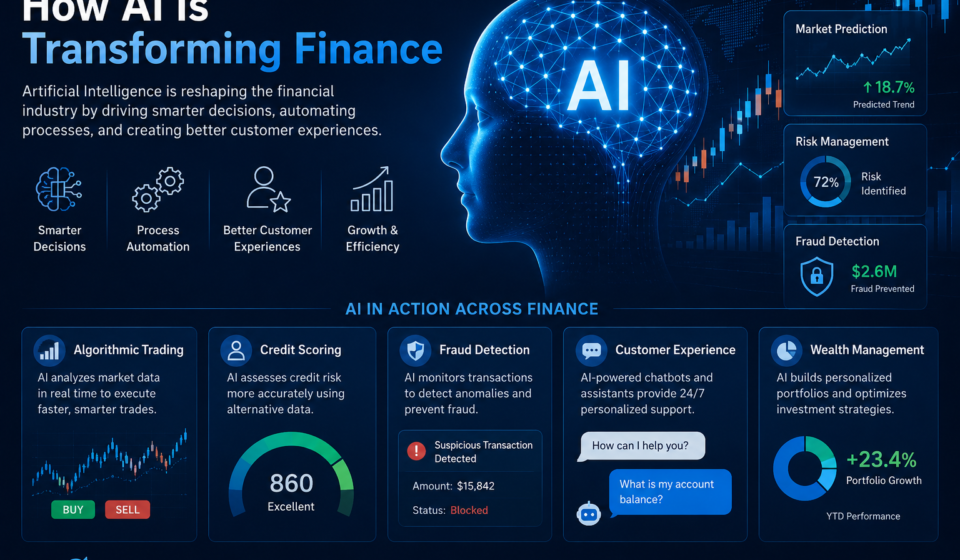

Artificial intelligence has become one of the most transformative technologies of the modern era, reshaping industries across the globe. Among the sectors experiencing the most significant changes is finance. From banking and investing to insurance, lending, fraud detection, and wealth management, artificial intelligence is revolutionizing how financial institutions operate and how consumers interact with financial services.
The financial industry has always relied heavily on data, analysis, and decision-making. Artificial intelligence enhances these capabilities by processing enormous amounts of information, identifying patterns, making predictions, and automating complex tasks with unprecedented speed and accuracy. As a result, financial organizations are becoming more efficient, cost-effective, and capable of delivering personalized experiences.
The rapid growth of artificial intelligence in finance has created new opportunities while also introducing challenges related to regulation, ethics, privacy, and cybersecurity. Understanding how AI is transforming finance is essential for investors, businesses, financial professionals, and consumers navigating today’s increasingly digital economy.
This guide explores the role of artificial intelligence in finance, its applications, benefits, challenges, and the future of AI-driven financial services.
What Is Artificial Intelligence in Finance?
Artificial intelligence in finance refers to the use of computer systems, machine learning algorithms, data analytics, and automation technologies to perform financial tasks that traditionally required human intelligence.
These systems can analyze large datasets, recognize patterns, make predictions, detect anomalies, automate processes, and assist in decision-making.
Unlike traditional software programs that follow predefined instructions, artificial intelligence systems can learn from data, improve performance over time, and adapt to changing conditions.
Financial institutions use AI to improve operational efficiency, reduce costs, manage risk, enhance customer experiences, and identify new business opportunities.
As technology continues to evolve, artificial intelligence is becoming an increasingly important component of modern financial systems.
Why the Financial Industry Is Adopting AI
The financial industry generates enormous amounts of data every day.
Banks, investment firms, insurance companies, payment providers, and financial institutions process millions of transactions, customer interactions, and market events continuously.
Managing and analyzing this volume of information manually is difficult, expensive, and time-consuming.
Artificial intelligence offers solutions by automating repetitive tasks, improving analytical capabilities, reducing human error, and increasing operational efficiency.
AI technologies also help organizations respond more quickly to changing market conditions and customer demands.
As competition intensifies and digital transformation accelerates, financial institutions increasingly view artificial intelligence as a strategic necessity.
The ability to leverage data effectively has become a critical competitive advantage.
AI in Banking
Banking represents one of the most significant areas of artificial intelligence adoption.
Banks use AI technologies to improve customer service, automate operations, detect fraud, assess risk, and enhance decision-making.
Artificial intelligence systems can process transactions, monitor account activity, analyze customer behavior, and provide personalized financial recommendations.
Automation reduces operational costs while improving accuracy and efficiency.
AI-powered customer support systems provide immediate assistance and handle routine inquiries without requiring human intervention.
Banks also use machine learning models to improve loan approval processes and credit assessments.
Digital transformation initiatives continue to expand the role of artificial intelligence throughout the banking industry.
AI-Powered Customer Service
Customer service has been significantly transformed by artificial intelligence.
Many financial institutions now use AI-powered chatbots and virtual assistants to interact with customers.
These systems can answer questions, process requests, provide account information, and assist with financial transactions.
Artificial intelligence allows customer service operations to function continuously, improving accessibility and response times.
Machine learning technologies enable these systems to improve their performance based on customer interactions.
AI-powered support solutions help reduce operational expenses while increasing customer satisfaction.
Human representatives remain important for complex situations, but artificial intelligence handles many routine interactions efficiently.
The combination of automation and personalization is reshaping customer experiences.
Fraud Detection and Prevention
Fraud detection is one of the most valuable applications of artificial intelligence in finance.
Financial fraud continues to evolve, becoming increasingly sophisticated and difficult to detect using traditional methods.
Artificial intelligence systems can analyze millions of transactions in real time and identify suspicious patterns or unusual activities.
Machine learning algorithms continuously learn from historical fraud data and adapt to emerging threats.
AI-powered fraud detection systems help financial institutions identify unauthorized transactions, identity theft, money laundering activities, and cybersecurity attacks.
Rapid detection reduces financial losses and protects customers.
As financial crimes become more complex, artificial intelligence plays an increasingly important role in maintaining financial security.
Artificial Intelligence in Lending
Lending decisions have traditionally relied on manual evaluation processes and standardized credit scoring models.
Artificial intelligence has introduced more sophisticated approaches to assessing borrower risk.
AI systems analyze large amounts of financial and behavioral data to evaluate creditworthiness more accurately.
These technologies may consider income patterns, spending behavior, employment history, financial obligations, and other relevant factors.
Automated underwriting systems can process loan applications more quickly while reducing administrative costs.
Artificial intelligence also helps lenders identify potential risks and improve portfolio management.
Enhanced data analysis capabilities contribute to more efficient lending decisions and improved access to credit.
AI in Investment Management
Investment management has experienced significant transformation due to artificial intelligence technologies.
Investment firms use machine learning algorithms to analyze financial markets, identify investment opportunities, and manage portfolios.
AI systems can process enormous volumes of market data, financial reports, economic indicators, and news information.
These technologies help investors identify patterns and trends that may not be apparent through traditional analysis methods.
Artificial intelligence also supports risk management, asset allocation, and portfolio optimization.
Many investment organizations now incorporate AI-driven strategies into their decision-making processes.
Technology continues to reshape how investment professionals analyze and manage financial assets.
Algorithmic Trading
Algorithmic trading represents one of the most prominent applications of artificial intelligence in financial markets.
These systems use computer algorithms to execute trades automatically based on predefined rules and market conditions.
Artificial intelligence enhances algorithmic trading by enabling systems to adapt to changing market environments and identify complex patterns.
High-frequency trading firms often use advanced AI technologies to execute transactions within fractions of a second.
Algorithmic trading can improve market efficiency and liquidity.
However, it also introduces challenges related to market volatility, regulation, and systemic risk.
Financial regulators closely monitor the growing use of automated trading technologies.
Artificial intelligence continues to influence the structure and behavior of global financial markets.
Robo-Advisors and Wealth Management
Artificial intelligence has transformed wealth management through the development of robo-advisors.
Robo-advisors use algorithms and automated systems to provide investment recommendations and portfolio management services.
These platforms assess investor goals, risk tolerance, financial circumstances, and investment preferences.
Based on this information, AI systems construct and manage diversified investment portfolios.
Robo-advisors typically offer lower fees and greater accessibility than traditional financial advisory services.
They have expanded access to investment management for individuals who may not have previously utilized professional financial advice.
While human advisors remain important for complex financial planning, artificial intelligence has significantly expanded wealth management services.
AI in Insurance
The insurance industry has also embraced artificial intelligence technologies.
Insurance companies use AI to assess risk, process claims, detect fraud, and improve customer service.
Machine learning models analyze historical data to estimate the likelihood of future claims and determine pricing strategies.
Artificial intelligence can automate claims processing and accelerate decision-making.
Fraud detection systems identify suspicious claims and reduce financial losses.
Personalized insurance products and pricing models have become increasingly feasible through advanced data analytics.
Artificial intelligence helps insurers improve operational efficiency while enhancing customer experiences.
Technological innovation continues to reshape the insurance sector.
Risk Management and Financial Analysis
Risk management remains one of the most important functions within finance.
Artificial intelligence improves risk analysis by processing vast amounts of structured and unstructured data.
Financial institutions use AI to evaluate credit risk, market risk, operational risk, and cybersecurity risk.
Machine learning systems identify patterns that may indicate emerging threats or vulnerabilities.
AI technologies also support stress testing, scenario analysis, and predictive modeling.
Enhanced analytical capabilities help organizations make more informed decisions and respond more effectively to changing conditions.
As financial markets become increasingly complex, artificial intelligence plays an essential role in managing uncertainty.
AI and Personalized Financial Services
Consumers increasingly expect personalized financial experiences.
Artificial intelligence enables financial institutions to provide customized recommendations, products, and services based on individual behavior and preferences.
AI systems analyze transaction histories, spending habits, savings patterns, and financial goals.
These insights allow financial institutions to deliver targeted financial advice and personalized product recommendations.
Personalization improves customer engagement and satisfaction.
Artificial intelligence also supports financial education by providing individualized guidance and recommendations.
As competition increases, personalized financial services are becoming an important differentiator in the financial industry.
Artificial Intelligence and Financial Inclusion
Artificial intelligence has the potential to improve financial inclusion worldwide.
Many individuals lack access to traditional financial services due to geographic, economic, or institutional barriers.
AI technologies can reduce operating costs and enable financial institutions to serve previously underserved populations.
Alternative credit assessment methods supported by artificial intelligence may expand access to loans and financial products.
Digital financial platforms powered by AI can reach remote communities more efficiently.
Improved access to financial services supports economic development and financial empowerment.
Artificial intelligence may play a significant role in reducing global financial inequality.
Challenges of AI in Finance
Despite its advantages, artificial intelligence presents several challenges.
Data privacy concerns remain significant because AI systems rely heavily on customer information and financial data.
Cybersecurity threats continue to evolve and require constant vigilance.
Algorithmic bias represents another concern because AI systems may unintentionally produce unfair or discriminatory outcomes.
Regulatory frameworks often struggle to keep pace with rapidly changing technologies.
The complexity of AI systems can also reduce transparency and make decision-making processes difficult to explain.
Financial institutions must balance innovation with ethical considerations, regulatory compliance, and consumer protection.
Responsible implementation remains essential for long-term success.
Artificial Intelligence and Employment in Finance
Artificial intelligence is changing the nature of work within the financial sector.
Automation reduces the need for certain repetitive and administrative tasks.
However, AI also creates new opportunities in data science, cybersecurity, technology development, and strategic analysis.
Many financial professionals are adapting by developing technical skills and focusing on higher-value activities.
Rather than completely replacing human workers, artificial intelligence often complements human expertise.
Collaboration between humans and intelligent systems is becoming increasingly important.
The future workforce in finance will likely require a combination of financial knowledge, technological skills, and analytical capabilities.
The Future of AI in Finance
The role of artificial intelligence in finance is expected to expand significantly in the coming years.
Advancements in machine learning, natural language processing, quantum computing, and predictive analytics may further transform financial services.
AI-powered financial assistants could become increasingly sophisticated and personalized.
Real-time risk analysis, automated compliance monitoring, and intelligent investment management may become standard features of financial systems.
Financial institutions will continue investing heavily in artificial intelligence technologies to improve competitiveness and efficiency.
At the same time, regulators and policymakers will face ongoing challenges related to governance, ethics, and financial stability.
Artificial intelligence is likely to remain one of the most influential forces shaping the future of finance.
Conclusion
Artificial intelligence is fundamentally transforming the financial industry by improving efficiency, enhancing decision-making, reducing costs, and creating more personalized financial experiences. From banking and investing to insurance, lending, and fraud detection, AI technologies are reshaping how financial institutions operate and how consumers manage their finances.
Although artificial intelligence introduces challenges related to regulation, privacy, ethics, and employment, its potential benefits remain substantial. Organizations that successfully integrate AI technologies while maintaining responsible practices may gain significant competitive advantages.
As technology continues to advance, artificial intelligence will play an increasingly important role in shaping the future of global finance. Understanding these developments is essential for businesses, investors, financial professionals, and consumers navigating the rapidly evolving financial landscape.
Frequently Asked Questions
What is artificial intelligence in finance?
Artificial intelligence in finance refers to the use of machine learning, automation, and data analysis technologies to perform financial tasks and improve decision-making.
How do banks use artificial intelligence?
Banks use AI for customer service, fraud detection, risk management, lending decisions, and operational automation.
What are robo-advisors?
Robo-advisors are automated investment platforms that use algorithms to provide portfolio management and financial advice.
How does AI help detect fraud?
AI analyzes transaction patterns and identifies suspicious activities in real time to prevent financial fraud.
Can artificial intelligence replace financial advisors?
AI can automate many financial tasks, but human advisors remain important for complex financial planning and personalized guidance.
How does AI improve lending decisions?
AI analyzes financial and behavioral data to assess creditworthiness more efficiently and accurately.
What are the risks of AI in finance?
Risks include data privacy concerns, cybersecurity threats, algorithmic bias, and regulatory challenges.
What is the future of artificial intelligence in finance?
The future of AI in finance includes greater automation, personalized financial services, improved risk management, and continued technological innovation.


