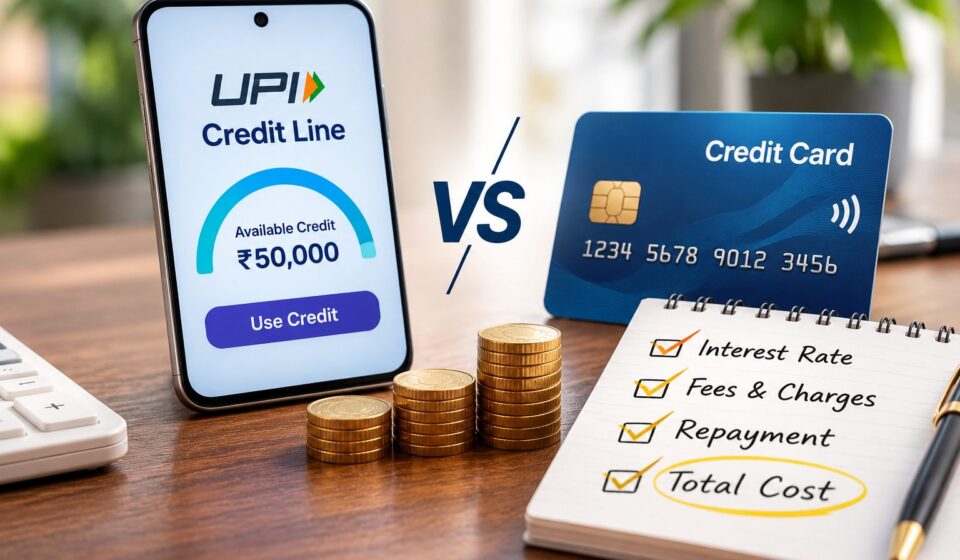

Paying for groceries, ordering food, booking travel or shopping online has become easier with digital payments. But a new development in India’s payment ecosystem is changing how people access short term credit.
Consumers can now use certain pre sanctioned bank credit lines through UPI, allowing them to make eligible payments without necessarily using a conventional credit card.
This creates an interesting comparison. If someone needs to borrow money for everyday purchases, should they use a UPI linked credit line or a credit card?
At first glance, both options appear similar. They allow customers to spend money they do not currently have in their bank accounts. However, their interest calculations, repayment arrangements, fees, reward benefits and eligibility requirements can differ considerably.
The cheaper option is not necessarily the one with the lowest advertised interest rate. What matters is how much the customer pays for the amount borrowed and how long that amount remains unpaid.
For Indian consumers, understanding these differences can help prevent unnecessary borrowing costs and make everyday financial decisions more manageable.
The First Difference: What Are You Actually Using?
Before comparing costs, it is important to distinguish between the two products.
UPI Credit Line
A UPI credit line is a pre sanctioned borrowing facility provided by an eligible bank and made available for permitted payments through the Unified Payments Interface.
Instead of paying directly from a savings account, the customer selects an eligible credit line as the funding source within a supported UPI application.
The payment is processed through UPI, but the money comes from the bank’s sanctioned credit facility.
For example, suppose a bank approves a credit line of ₹30,000 for a customer.
The customer can use the available amount for eligible transactions, subject to the bank’s conditions and applicable transaction restrictions.
Interest and repayment obligations depend on the specific credit product.
The Reserve Bank of India enabled the operation of pre sanctioned bank credit lines through UPI, with customer consent and terms determined by the issuing bank.
Credit Card
A credit card is a revolving credit facility issued by a bank or eligible financial institution.
The customer receives a predetermined spending limit and can use it for eligible purchases at merchants, online stores and other supported payment locations.
The amount spent becomes part of the outstanding credit card balance.
The issuer generates a monthly statement showing transactions, the total amount due and the payment deadline.
If the customer pays the entire statement balance by the due date and satisfies the applicable conditions, eligible retail purchases may benefit from an interest free period.
If the customer carries an unpaid balance beyond the payment deadline, interest and other applicable charges can increase the cost of borrowing.
A Side by Side Comparison
The following comparison highlights the major differences between the two borrowing options.
| Feature | UPI Credit Line | Credit Card |
|---|---|---|
| Credit provider | Eligible issuing bank | Card issuing bank or institution |
| Payment method | Supported UPI applications | Card network and supported payment channels |
| Credit availability | Pre sanctioned bank limit | Approved card limit |
| Interest calculation | Based on facility terms and utilisation | Depends on billing cycle and outstanding balance |
| Interest free period | Depends on the specific product | Usually available for eligible purchases when conditions are met |
| Monthly statement | Depends on the credit facility | Standard card billing statement |
| Rewards | Product dependent | May include cashback, points or other benefits |
| ATM cash withdrawal | Product dependent and generally not an assumed feature | Often available, but usually expensive |
| Repayment | As specified by the issuing bank | According to the statement and payment terms |
| Eligibility | Subject to bank approval | Subject to card issuer approval |
One important distinction is that a UPI credit line and a RuPay credit card linked to UPI are not the same product.
Both may be used through a UPI application, but their underlying credit arrangements differ.
The Real Question: Which One Charges More Interest?
Interest is usually the biggest factor when comparing borrowing costs.
However, there is no universal interest rate for UPI credit lines.
Each issuing bank may establish its own terms, including the credit limit, repayment period and applicable interest rate.
Credit cards also have different interest rates depending on the issuer and card product.
The difference becomes clearer when examining how interest is charged.
How UPI Credit Line Interest Works
Suppose a customer has a UPI credit line of ₹50,000 and uses ₹10,000 for eligible purchases.
The utilised amount becomes a borrowing obligation.
Depending on the product, interest may begin accruing from the date of utilisation.
Some facilities may use a repayment schedule or EMI structure, while others may have different repayment arrangements.
The customer should examine the applicable interest rate, calculation method, billing cycle and repayment deadline before using the facility.
How Credit Card Interest Works
Credit cards commonly provide an interest free period for eligible retail purchases.
This period depends on the card’s billing cycle and the date of the transaction.
If the cardholder pays the entire statement balance by the due date, interest may not be charged on eligible purchases.
However, paying only the minimum amount due does not provide the same benefit.
The remaining balance can attract interest according to the card’s terms.
This is why credit cards can be particularly economical for customers who consistently repay their full statement balance.
A Practical Cost Calculation: Borrowing ₹20,000
Consider two customers who need ₹20,000 for everyday purchases.
Customer A uses a UPI credit line with an illustrative annual interest rate of 18%.
Customer B uses a credit card with an illustrative annual interest rate of 36%.
Assume both customers carry the entire ₹20,000 outstanding for 30 days.
For a simplified comparison, use the following formula:
[
\text{Interest}=\frac{\text{Principal}\times\text{Annual Rate}\times\text{Days}}{365}
]
<box border radius=”lg” padding={3} gap={3}> **Illustrative borrowing cost** <text color=”secondary” size=”xs”>₹20,000 outstanding for 30 days. Rates are hypothetical and exclude fees and taxes.</text> <grid columns={2} gap={2}> <grid-item> <box background=”surface-secondary” radius=”md” padding={3} gap={1}> <text color=”secondary” size=”xs” weight=”medium”>UPI CREDIT LINE</text> <title size=”2xl” color=”success” tabularNums>₹296</title> <text color=”secondary” size=”xs”>At 18% annually</text> </box> </grid-item> <grid-item> <box background=”surface-secondary” radius=”md” padding={3} gap={1}> <text color=”secondary” size=”xs” weight=”medium”>CREDIT CARD</text> <title size=”2xl” tabularNums>₹592</title> <text color=”secondary” size=”xs”>At 36% annually</text> </box> </grid-item> </grid> <divider color=”subtle”/> <row justify=”between” align=”center”> **Illustrative difference** <title size=”xl” color=”success” tabularNums>₹296</title> </row> </box>
In this particular example, the UPI credit line costs less because its assumed interest rate is lower.
But the comparison changes if the credit card customer pays the full statement balance within the eligible interest free period.
In that situation, the credit card customer could pay zero purchase interest, while the UPI credit line customer may still owe interest.
This is why comparing advertised interest rates alone can produce the wrong conclusion.
Five Charges That Can Change the Final Cost
Interest is only one part of borrowing expenses. Other charges can make an apparently affordable credit product more expensive.
1. Processing Fees
Some UPI credit line products may charge a processing fee when the facility is activated or used.
Credit cards may also have joining or annual fees.
A customer should check whether these charges are one time, recurring or conditional.
2. Late Payment Charges
Missing a repayment deadline can create additional expenses.
Credit cards may impose late payment fees according to their terms.
UPI credit line providers may also apply penal charges or other permitted fees when borrowers fail to meet repayment obligations.
The exact amounts should be checked before accepting the facility.
3. GST and Applicable Taxes
Applicable taxes may increase the final cost of financial services.
For example, GST may apply to eligible banking charges and fees.
Customers should distinguish between the interest amount and taxes imposed on applicable charges.
4. EMI Conversion Charges
Some credit cards allow customers to convert eligible purchases into EMIs.
However, the conversion may involve interest, processing fees and applicable taxes.
Certain UPI credit facilities may also offer structured repayment options.
Compare the total amount payable rather than looking only at the monthly instalment.
5. Cash Withdrawal Charges
Credit card cash advances can be particularly expensive.
They may involve withdrawal fees and interest from the transaction date, without the usual interest free period.
A UPI credit line should not be assumed to provide ATM cash withdrawal facilities.
Its permitted use depends on the issuing bank’s product conditions.
Where Credit Cards Have an Advantage
Credit cards remain useful because they offer features that many UPI credit line products may not provide.
Interest Free Purchase Period
This is one of the biggest financial advantages.
A customer who makes eligible purchases and pays the full statement balance by the due date can avoid purchase interest.
The exact interest free period depends on the billing cycle and card conditions.
Cashback and Reward Points
Some credit cards provide rewards on groceries, travel, dining, shopping and other categories.
For regular users who pay their bills in full, these benefits can reduce the effective cost of spending.
However, rewards should never justify unnecessary purchases.
Purchase Protection and Other Benefits
Depending on the card, customers may receive benefits such as transaction dispute support, purchase protection, travel privileges or insurance related features.
The availability and coverage of these benefits vary by product.
Established International Acceptance
Credit cards can be useful for international purchases, hotel bookings and travel reservations, subject to card network acceptance and applicable foreign currency charges.
A UPI credit line should not be assumed to offer the same international acceptance.
Where UPI Credit Lines Can Be More Convenient
UPI credit lines offer a different kind of convenience.
Their main attraction is the ability to use an approved credit facility through the familiar UPI payment experience.
No Need to Carry a Physical Card
Customers can make eligible payments using a supported UPI application.
This may be convenient for small merchants and everyday purchases.
Access to Credit Through Existing Payment Infrastructure
Customers who already use UPI regularly may find it easier to manage payments through an interface they understand.
Potentially Different Pricing Structures
Some bank credit lines may have interest rates or repayment conditions that compare favourably with revolving credit card borrowing.
This depends entirely on the specific offer.
Transaction Tracking
Supported UPI applications may display credit line details, including utilised amounts and other facility information.
This can make it easier to monitor spending, although customers should still review their official account statements.
An Important Distinction: UPI Credit Line vs RuPay Credit Card on UPI
Many consumers use the term UPI credit payment to describe different products.
This can create confusion.
A RuPay credit card linked to UPI allows eligible cardholders to make merchant payments using their credit card through a supported UPI application.
A UPI credit line uses a bank sanctioned credit facility as the payment source.
The difference is important because the interest, billing, repayment and reward structures may not be identical.
For example, a RuPay credit card linked to UPI generally follows the card’s billing and repayment conditions.
A bank credit line follows the terms of its underlying credit facility.
Customers should identify which product they are actually using before comparing its cost.
Three Spending Situations: Which Option Makes More Sense?
The most suitable choice depends on the customer’s spending habits.
Situation 1: You repay every month
Suppose you spend ₹15,000 through a credit card and always pay the complete statement balance before the due date.
If the purchases qualify for the interest free period, the card may be cheaper than an interest bearing UPI credit line.
Reward benefits can provide an additional advantage.
Situation 2: You need several weeks to repay
Suppose you borrow ₹20,000 and expect to repay it over the next 30 to 45 days.
If your UPI credit line has a lower effective interest rate and reasonable fees, it may cost less than carrying a credit card balance.
Compare the actual charges before deciding.
Situation 3: You need a longer repayment period
Suppose you need ₹60,000 and want to repay it over six months.
Neither product should be selected based only on the convenience of payment.
Compare the EMI, interest rate, processing fees, repayment conditions and total amount payable.
A suitable personal loan or structured credit facility may also be worth evaluating.
A Simple Decision Guide
| Your financial situation | Option worth examining first |
|---|---|
| You pay the full card bill every month | Credit card |
| You want cashback and reward points | Suitable rewards credit card |
| Your bank offers a lower cost UPI credit line | UPI credit line |
| You need a short term merchant payment facility | Compare both product terms |
| You regularly carry unpaid card balances | Lower cost credit alternative |
| You need a longer repayment period | Compare structured loan options |
This is a starting point, not a universal recommendation. The final decision should be based on the actual borrowing agreement.
Mistakes That Make Both Options Expensive
Even a competitively priced credit product can become costly when used without a repayment plan.
Paying only the minimum due: This keeps the credit card account from becoming immediately overdue under applicable terms, but the remaining balance can continue attracting interest.
Ignoring the statement date: Understanding the billing cycle helps cardholders plan repayments and use the interest free period effectively.
Using credit for unnecessary purchases: Convenient payment options can encourage spending beyond available income.
Ignoring total repayment: A low EMI can hide a high overall borrowing cost.
Using multiple credit facilities simultaneously: Managing several outstanding balances can make repayment difficult.
Missing payment deadlines: Late fees and potential credit history consequences can make short term borrowing more expensive.
How These Products Can Affect Your Credit Score
Both products involve borrowing, so repayment behaviour matters.
Responsible use and timely repayment can contribute positively to a borrower’s credit history, depending on how the facility is reported by the lender and recognised by the credit information company.
However, consistently using a large portion of the available credit limit may affect credit utilisation measurements where applicable.
Missed payments, overdue balances and defaults can damage creditworthiness.
Customers should also remember that a UPI payment interface does not turn a credit transaction into a debit transaction. Borrowed money still needs to be repaid.
Maintaining a repayment buffer and avoiding unnecessary borrowing are important regardless of the payment method.
What Should Consumers Check Before Choosing?
Before activating either facility, examine these details:
- Annual interest rate and how interest is calculated.
- Processing and annual fees.
- Repayment deadline and billing cycle.
- EMI conversion charges, if applicable.
- Late payment and penal charges.
- Applicable taxes.
- Permitted transaction categories.
- Rewards and cashback conditions.
- Credit limit and available balance.
- Total repayment amount.
For UPI credit lines, ask the bank whether interest begins immediately after utilisation and whether the product offers a grace period.
For credit cards, understand the conditions required to retain the interest free period.
These two questions alone can significantly change the cost comparison.
Final Verdict: UPI Credit Line or Credit Card?
There is no single winner for every Indian consumer.
A credit card can be the cheaper option for disciplined users who pay their entire statement balance within the interest free period and make meaningful use of rewards.
A UPI credit line may be more economical for borrowers who need short term credit and receive a genuinely lower interest rate with reasonable charges.
The difference comes down to repayment behaviour and product pricing.
Consumers should not assume that every UPI credit line is cheaper than a credit card or that every credit card offers free borrowing.
Compare the complete cost, understand when interest starts and select the facility that matches your repayment capacity.
The smartest borrowing decision is not about choosing the newest payment technology. It is about accessing credit without allowing convenience to turn into an expensive financial habit.
Frequently Asked Questions
1. Is UPI credit line cheaper than a credit card?
It depends on the interest rate, fees and repayment period. A UPI credit line may be cheaper when its borrowing rate is lower. However, a credit card can cost less when the entire eligible statement balance is paid within the interest free period.
2. Can I use a UPI credit line for everyday purchases?
Yes, eligible UPI credit lines can be used for permitted transactions through supported applications. However, the issuing bank may restrict certain merchant categories or transaction types.
3. Does UPI credit line have an interest free period?
There is no universal interest free period across all UPI credit line products. The interest calculation and repayment conditions are determined by the issuing bank.
4. Can I link my credit card to UPI?
Eligible RuPay credit cards can be linked to supported UPI applications for permitted merchant payments. Other card networks may have different linking arrangements.
5. Is UPI credit line the same as RuPay credit card on UPI?
No. A UPI credit line uses a bank sanctioned credit facility, whereas a RuPay credit card linked to UPI uses an existing credit card account. Their billing and repayment terms can differ.
6. Do UPI credit lines charge processing fees?
Some banks may charge processing or other applicable fees. Customers should check the product’s official terms before activating or using the facility.
7. Can I withdraw cash using a UPI credit line?
Customers should not assume that a UPI credit line supports ATM withdrawals. Its permitted usage depends on the issuing bank’s conditions and applicable regulations.
8. What happens if I do not repay my UPI credit line on time?
The bank may apply applicable penal charges and other contractual consequences. Delayed repayment may also affect your credit history if the facility is reported to credit information companies.
9. Do credit card rewards make them cheaper?
Rewards can reduce the effective cost of eligible purchases. However, they do not compensate for high interest charges if you carry unpaid balances. Always compare the complete financial cost.
10. Can using UPI credit line improve my credit score?
Responsible repayment may contribute to a positive credit history if the issuing bank reports the facility to credit information companies. The impact depends on the reporting arrangement and overall credit behaviour.
11. Which is better for someone who frequently uses UPI?
A UPI credit line may offer greater payment convenience, but convenience alone does not establish that it is cheaper. Compare the bank’s interest rate, permitted transactions and repayment conditions with your existing credit card.
12. Should I use both a UPI credit line and a credit card?
You can maintain both if you qualify and can manage the repayment obligations. However, having access to multiple credit facilities should not become a reason to increase unnecessary spending.