
An unexpected expense can disrupt even a carefully planned monthly budget. A job loss, urgent medical bill, home repair or sudden family responsibility can force people to borrow money or withdraw from investments at the wrong time. An emergency fund helps prevent these situations from becoming larger financial problems.
But how much money should you actually keep aside? Is ₹50,000 enough? Should someone earning ₹50,000 a month save ₹2 lakh? And does a person earning ₹1.5 lakh need a much larger reserve?
The answer depends less on your salary and more on how much you need to maintain your household when your regular income is interrupted.
A widely used starting point is to save enough to cover three to six months of essential expenses. People with irregular income, dependants or limited job security may need a larger reserve.
Start With Your Essential Monthly Expenses
Your emergency fund should cover the expenses you cannot easily avoid. It is not meant to replace your entire salary or maintain every part of your usual lifestyle.
Consider a household with a monthly income of ₹60,000.
Its spending might look like this:
| Expense | Monthly amount |
|---|---|
| Rent | ₹12,000 |
| Groceries | ₹7,000 |
| Electricity, water and phone | ₹2,500 |
| Transport | ₹3,500 |
| Insurance premiums | ₹2,000 |
| Essential medicines and healthcare | ₹2,000 |
| School fees and family responsibilities | ₹5,000 |
| Total essential expenses | ₹34,000 |
The household spends another ₹8,000 on dining out, shopping, entertainment and other optional purchases. Those expenses can be reduced during a financial emergency.
For this household, the emergency fund calculation should use ₹34,000 rather than the full ₹60,000 income.
Three months of essential expenses would equal ₹1,02,000. Six months would equal ₹2,04,000.
This gives the household a practical target instead of an arbitrary savings number.
The Simple Emergency Fund Formula
You can calculate your target using one straightforward formula:
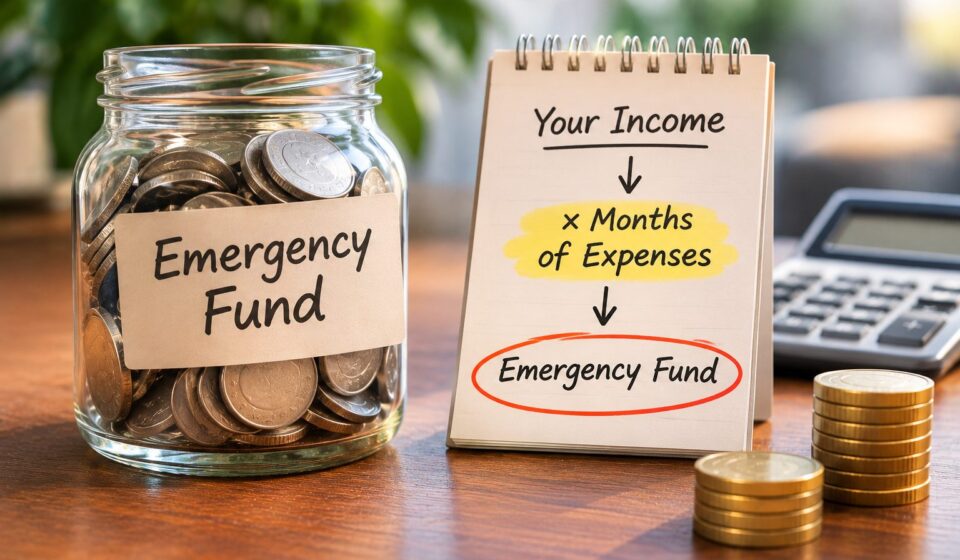
Emergency fund = Monthly essential expenses × Number of months of coverage
For example:
- Essential monthly expenses: ₹40,000
- Desired coverage: Six months
- Required emergency fund: ₹2,40,000
The number of months depends on your financial circumstances.
| Financial situation | Suggested starting coverage |
|---|---|
| Stable job with two earning members | 3 to 4 months |
| Stable single income household | 4 to 6 months |
| Household with dependants | 6 months |
| Freelancers and independent professionals | 6 to 9 months |
| Business owners with unpredictable income | 6 to 12 months |
| Single earner with limited job opportunities | 6 to 12 months |
These are planning guidelines, not fixed rules. Your actual target should reflect your responsibilities, income reliability and access to other financial support.
How Much Should You Save at Different Income Levels?
People often look for an emergency fund target based on their monthly salary. Income can provide a useful starting point, but the following examples assume that essential expenses represent a portion of take home income.
The figures below use six months of essential expenses as the target.
| Monthly income | Assumed essential expenses | Six month emergency fund |
|---|---|---|
| ₹30,000 | ₹20,000 | ₹1,20,000 |
| ₹50,000 | ₹32,000 | ₹1,92,000 |
| ₹75,000 | ₹45,000 | ₹2,70,000 |
| ₹1,00,000 | ₹60,000 | ₹3,60,000 |
| ₹1,50,000 | ₹90,000 | ₹5,40,000 |
| ₹2,00,000 | ₹1,15,000 | ₹6,90,000 |
These are illustrative calculations, not recommended amounts for every person earning that salary. Someone earning ₹75,000 and spending only ₹30,000 on essentials would need a smaller reserve than someone with the same income and ₹55,000 in unavoidable monthly commitments.
The important number is the amount required to keep your household running, not the amount credited to your bank account.
Three Examples That Show Why Income Is Not Everything
Example 1: A salaried employee earning ₹40,000
Suppose a person earns ₹40,000 and spends ₹25,000 on rent, food, transport, utilities and other necessary expenses.
A three month reserve would be ₹75,000. A six month reserve would be ₹1,50,000.
If this person has a stable job, no major dependants and reliable insurance, starting with the lower target may be reasonable.
Example 2: A family earning ₹1 lakh
A household earns ₹1 lakh every month, but its essential expenses total ₹75,000 because of rent, school fees, loan payments and family responsibilities.
Six months of coverage requires ₹4,50,000.
Despite having a higher income, this household needs a substantial emergency reserve because its monthly commitments are also higher.
Example 3: A freelancer earning ₹80,000
A freelancer may earn ₹80,000 in one month and only ₹35,000 in another. Even if average income looks comfortable, payments can be delayed or projects can disappear.
If essential monthly expenses are ₹40,000, a nine month reserve would be ₹3,60,000.
The larger reserve provides more time to find new clients without accepting unsuitable work simply to cover immediate bills.
What Should Your Emergency Fund Cover?
An emergency fund should protect your basic financial stability. Before calculating the final amount, identify the expenses that would continue even if your income stopped.
Include:
- Rent or essential home loan payments
- Groceries and basic household supplies
- Electricity, water, gas and essential phone services
- Transport required for work and daily responsibilities
- Insurance premiums
- Necessary medical expenses
- School fees and essential dependant costs
- Minimum payments on outstanding debts
You may also add a reasonable allowance for unexpected repairs or urgent travel.
However, do not include every expense from your normal lifestyle. Holidays, expensive shopping, subscriptions, restaurant visits and entertainment can usually be paused during an emergency.
The purpose is to preserve essential living standards, not to fund your usual spending habits.
Where Should You Keep Your Emergency Savings?
An emergency fund has a different purpose from an investment portfolio. Its main priorities are accessibility and capital preservation.
You should be able to access the money when an urgent situation occurs without depending on stock market conditions.
1. Savings account
A savings account is suitable for the portion of your fund that you may need immediately. It offers convenient access through normal banking channels.
Keep enough money here to handle urgent expenses without waiting for another investment to be redeemed.
2. Sweep fixed deposit
A sweep facility can automatically move money between a savings account and a linked fixed deposit, depending on the bank’s terms.
It may offer a better interest rate on money that is not immediately required. Check withdrawal rules, premature closure conditions and any applicable charges before using it.
3. Liquid mutual funds
Some people use liquid mutual funds for part of their emergency savings. These funds invest in short maturity debt and money market instruments.
However, they are mutual fund investments, not bank deposits. Returns are not guaranteed, and there can be credit, liquidity and market related risks. Redemption timelines and applicable charges should be checked before investing.
Avoid placing the entire emergency fund in products that may delay access or expose the money to substantial fluctuations.
A practical arrangement is to keep the immediately accessible portion in a savings account and hold the remaining amount in suitable low risk, easily accessible instruments.
How to Build Your Emergency Fund Without Feeling Financially Stretched
You do not need to save the entire target immediately. Building a reserve gradually is often more sustainable than making an aggressive savings commitment that becomes difficult to maintain.
Try the following approach.
Step 1: Set a first milestone
Start with one month of essential expenses. If your monthly essentials are ₹30,000, your first target is ₹30,000.
This initial reserve can provide some protection against smaller unexpected expenses.
Step 2: Automate monthly savings
Set up an automatic transfer shortly after your salary arrives. Even ₹2,000 or ₹3,000 each month can build a useful reserve over time.
Step 3: Direct additional income towards savings
Use part of your annual bonus, freelance payment, incentive or other unexpected income to strengthen the fund.
You do not need to allocate every additional rupee. A consistent contribution is more important than an occasional large deposit.
Step 4: Increase contributions when your income grows
If your salary increases from ₹50,000 to ₹60,000, consider increasing your monthly emergency fund contribution instead of allowing all the additional income to become new spending.
Step 5: Review the target regularly
Your essential expenses may change when you move homes, take on a loan, have a child or become responsible for another family member.
Recalculate the target whenever your financial responsibilities change significantly.
When Should You Actually Use Your Emergency Fund?
Not every unexpected purchase qualifies as an emergency. The fund should be reserved for situations that threaten your financial stability or require immediate attention.
Appropriate reasons include:
- Sudden loss of employment
- Unplanned medical treatment
- Urgent home repairs
- Essential vehicle repairs needed for daily travel
- Emergency family responsibilities
- A temporary interruption in business or freelance income
It is generally not appropriate to use this money for a holiday, a new phone, a sale purchase or an investment opportunity.
If you use part of the fund, make rebuilding it a priority once your financial situation improves.
Common Emergency Fund Mistakes to Avoid
Even people who save regularly can make mistakes when deciding where to keep their emergency money.
Treating the fund as spare spending money: Keeping emergency savings in the same account used for everyday purchases can make it easier to spend without noticing.
Investing everything in shares: Equity investments can fall sharply just when you need money. An emergency reserve should not depend on favourable market conditions.
Ignoring insurance: An emergency fund and insurance serve different purposes. Health and other appropriate insurance can reduce the financial impact of major events, while the emergency fund helps cover deductibles, uncovered expenses and everyday costs during an income interruption.
Choosing an unrealistic target: A target that is too large may discourage you from starting. Build the reserve in stages and increase it as your circumstances allow.
Forgetting inflation and rising expenses: A reserve calculated several years ago may no longer be sufficient. Review it periodically.
A Practical Emergency Fund Checklist
Before deciding that your emergency fund is complete, check whether it meets these conditions:
- Your essential monthly expenses have been calculated.
- Your target reflects your income stability and family responsibilities.
- You can access part of the money immediately.
- The money is not dependent on stock market performance.
- You have considered insurance and existing debt commitments.
- You have a plan to replenish the fund after using it.
- You review the amount when your expenses or responsibilities change.
Final Thoughts
The right emergency fund is not determined by a universal salary based number. It is determined by how much money your household needs to remain financially stable when regular income is interrupted.
Start by calculating essential monthly expenses, choose an appropriate coverage period and build your reserve one milestone at a time.
For someone with stable employment, three to six months of essential expenses can be a useful starting point. Those with irregular earnings, dependants or greater financial uncertainty may benefit from keeping more.
You do not need to build the perfect emergency fund in one month. What matters is starting early, keeping the money accessible and reviewing the amount as life changes.
Frequently Asked Questions
1. How many months of salary should an emergency fund cover?
An emergency fund should generally cover three to six months of essential expenses rather than three to six months of full salary. People with irregular income or greater family responsibilities may need six to twelve months of coverage.
2. Is ₹1 lakh enough for an emergency fund?
It depends on your monthly essential expenses. If you need ₹20,000 each month, ₹1 lakh provides five months of coverage. If your essential expenses are ₹50,000, it covers only two months.
3. Should I build an emergency fund before investing?
It is sensible to establish an initial emergency reserve before committing significant amounts to long term investments. This reduces the chance of selling investments at an unfavourable time to meet urgent expenses.
4. Can I keep my emergency fund in a fixed deposit?
Yes. A fixed deposit can be used for part of an emergency fund if it allows suitable access. Check premature withdrawal conditions and avoid locking away the entire reserve.
5. Are liquid mutual funds suitable for emergency savings?
They may be suitable for a portion of the reserve, depending on your risk tolerance and access requirements. However, they are market linked investments and do not offer guaranteed returns or the same protection as eligible bank deposits.
6. Should I include loan EMIs in my emergency fund calculation?
Yes. Include essential loan payments that would continue during an income interruption. Ignoring these commitments can leave your emergency fund too small.
7. Do people with two salaries need an emergency fund?
Yes. Two incomes may reduce the risk of losing all household income at once, but both earners could face job changes or other unexpected events. The fund should reflect the stability of both incomes and the household’s essential expenses.
8. How much should freelancers save?
Freelancers may consider keeping six to nine months of essential expenses, or more when client payments are highly unpredictable. The appropriate amount depends on income consistency, savings and family responsibilities.
9. Should emergency savings earn interest?
Earning interest can help preserve the value of savings, but accessibility and capital preservation should come first. Avoid choosing an instrument solely because it advertises a higher return.
10. What should I do after using my emergency fund?
First, handle the emergency and assess your remaining savings. Then temporarily increase contributions towards rebuilding the fund. Avoid treating money used for a genuine emergency as a financial failure.
11. Is an emergency fund necessary if I have health insurance?
Yes. Health insurance may cover eligible medical expenses, but it may not cover every cost. You may still need money for deductibles, excluded treatments, travel, daily household expenses or an interruption in income.
12. How often should I review my emergency fund?
Review it at least once a year and whenever your income, household expenses, debt commitments or family responsibilities change significantly.