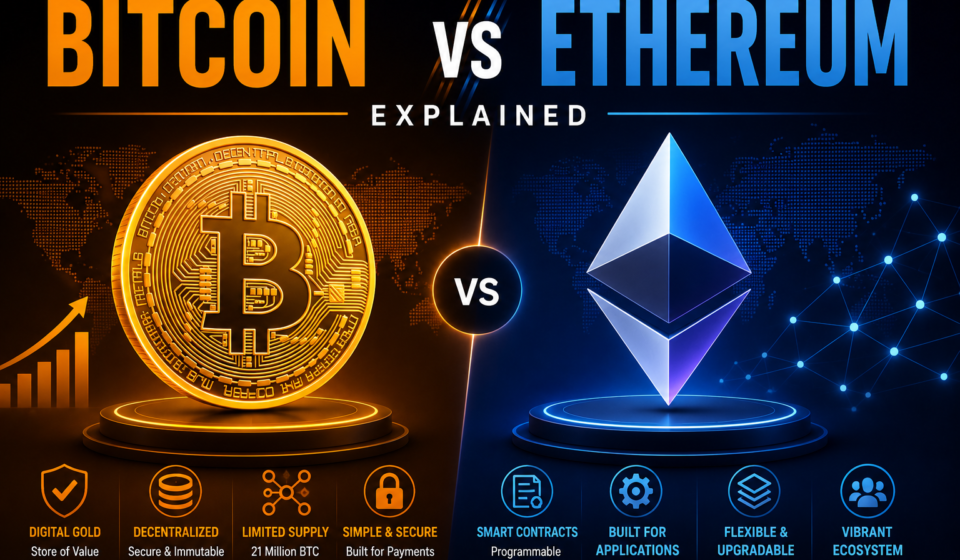

Cryptocurrencies have transformed the financial world by introducing decentralized digital assets that operate without traditional banks or governments. Among the thousands of cryptocurrencies available today, Bitcoin and Ethereum remain the two most recognized and widely used. While both rely on blockchain technology and share some similarities, they were created with different goals and serve distinct purposes.
Bitcoin is primarily viewed as a digital store of value and a decentralized form of money, whereas Ethereum is a programmable blockchain that enables developers to build decentralized applications and smart contracts. Understanding the differences between these two leading cryptocurrencies can help investors, developers, and technology enthusiasts make more informed decisions.
This guide explains Bitcoin and Ethereum, how they work, their key differences, advantages, challenges, and their roles in the evolving digital economy.
What Is Bitcoin?
Bitcoin is the world’s first decentralized cryptocurrency. It was introduced in 2009 by an anonymous individual or group using the name Satoshi Nakamoto.
Bitcoin was designed to allow people to send and receive digital money without relying on banks or other financial intermediaries. Transactions are verified by a decentralized network of computers and recorded on a public blockchain.
Many investors view Bitcoin as “digital gold” because of its limited supply and potential as a long-term store of value.
What Is Ethereum?
Ethereum is a decentralized blockchain platform launched in 2015 by Vitalik Buterin and a team of developers.
Unlike Bitcoin, Ethereum was built to support programmable smart contracts and decentralized applications (commonly called dApps). Its native cryptocurrency, Ether (ETH), is used to pay transaction fees and power applications running on the Ethereum network.
Ethereum has become the foundation for many innovations in decentralized finance (DeFi), non-fungible tokens (NFTs), blockchain gaming, and Web3 technologies.
How Bitcoin Works
Bitcoin operates through a decentralized network of computers known as nodes.
When someone sends Bitcoin:
- The transaction is broadcast to the network.
- Network participants verify its validity.
- Verified transactions are added to the blockchain.
- The blockchain permanently records the transaction.
Bitcoin’s supply is limited to 21 million coins, making scarcity one of its defining characteristics.
How Ethereum Works
Ethereum also uses blockchain technology but supports far more than simple value transfers.
The Ethereum network allows developers to create:
- Smart contracts
- Decentralized applications
- Digital tokens
- Decentralized finance platforms
- NFT marketplaces
- Blockchain-based games
Transactions and applications are powered using Ether, which pays the network’s processing fees.
Bitcoin vs Ethereum: Key Differences
| Feature | Bitcoin | Ethereum |
|---|---|---|
| Launch Year | 2009 | 2015 |
| Primary Purpose | Digital currency and store of value | Smart contracts and decentralized applications |
| Native Coin | Bitcoin (BTC) | Ether (ETH) |
| Supply | Limited to 21 million BTC | No fixed maximum supply, though issuance is managed by the protocol |
| Main Use Case | Payments and long-term value storage | Decentralized applications, DeFi, NFTs, Web3 |
| Smart Contracts | Limited functionality | Extensive smart contract support |
| Ecosystem | Digital payments and investment | Broad blockchain development platform |
Advantages of Bitcoin
Bitcoin offers several benefits.
Limited Supply
Its fixed supply creates scarcity, which many investors believe supports long-term value.
Decentralization
Bitcoin operates without a central authority, reducing reliance on traditional financial institutions.
Global Accessibility
Anyone with internet access and a compatible wallet can send or receive Bitcoin.
Security
Bitcoin’s blockchain is protected by one of the largest decentralized computing networks in the world.
Recognition
Bitcoin remains the most widely recognized cryptocurrency and is often the first digital asset new investors encounter.
Advantages of Ethereum
Ethereum provides unique capabilities beyond digital payments.
Smart Contracts
Developers can automate agreements without intermediaries.
Decentralized Applications
Thousands of applications run on Ethereum across finance, gaming, identity, and digital collectibles.
Large Developer Community
Ethereum has one of the most active blockchain developer ecosystems.
Innovation
Many blockchain innovations first emerge within Ethereum’s ecosystem before expanding to other networks.
Flexible Platform
Ethereum continues evolving through upgrades designed to improve scalability, efficiency, and security.
Challenges of Bitcoin
Bitcoin also faces certain limitations.
Common challenges include:
- Price volatility
- Network congestion during periods of heavy activity
- Limited smart contract functionality
- Regulatory uncertainty in some regions
- Environmental concerns historically associated with mining, though energy sources vary widely
Challenges of Ethereum
Ethereum faces its own challenges.
These include:
- Network congestion
- Transaction fees that can increase during high demand
- Competition from other smart contract platforms
- Ongoing technical upgrades
- Regulatory developments affecting blockchain applications
Despite these challenges, Ethereum remains one of the leading blockchain platforms.
Which Is Better for Investors?
The answer depends on an investor’s objectives.
Some investors choose Bitcoin because they view it as a long-term store of value similar to digital gold.
Others invest in Ethereum because they believe decentralized applications, smart contracts, and blockchain innovation will drive future growth.
Many diversified cryptocurrency investors choose to hold both Bitcoin and Ethereum because they serve different roles within the digital asset ecosystem.
Bitcoin and Ethereum in Everyday Use
Bitcoin is commonly used for:
- Long-term investing
- International transfers
- Digital payments where accepted
- Portfolio diversification
Ethereum supports:
- Decentralized finance (DeFi)
- NFT marketplaces
- Blockchain gaming
- Web3 applications
- Token creation
- Decentralized autonomous organizations (DAOs)
Each network serves different user needs.
Common Misconceptions
Several myths continue to surround Bitcoin and Ethereum.
They Are the Same Cryptocurrency
Although both use blockchain technology, Bitcoin and Ethereum have different objectives, technologies, and ecosystems.
Cryptocurrencies Are Anonymous
Most blockchain transactions are publicly recorded. While wallet addresses do not directly reveal identities, blockchain activity is generally transparent and traceable.
Bitcoin and Ethereum Are Only Used for Investing
Both networks support a variety of use cases, including payments, software development, decentralized finance, digital ownership, and more.
Ethereum Is Just Another Cryptocurrency
Ethereum is not only a cryptocurrency but also a programmable blockchain platform supporting thousands of decentralized applications.
The Future of Bitcoin and Ethereum
Both cryptocurrencies continue to evolve.
Future developments may include:
- Broader institutional adoption
- Improved blockchain scalability
- Greater regulatory clarity
- Enhanced security features
- Expansion of decentralized finance
- Continued Web3 innovation
- Integration with traditional financial systems
- Increased enterprise blockchain adoption
While future adoption remains uncertain, both Bitcoin and Ethereum continue to play significant roles in the broader cryptocurrency ecosystem.
Final Thoughts
Bitcoin and Ethereum represent two of the most influential innovations in blockchain technology, but they were designed with different purposes in mind. Bitcoin focuses on providing a decentralized digital currency and store of value, while Ethereum offers a flexible platform for smart contracts and decentralized applications.
Neither cryptocurrency is inherently better than the other. Bitcoin is often favored for its simplicity, security, and scarcity, whereas Ethereum is recognized for its versatility and support for blockchain-based innovation. Understanding their unique strengths and limitations can help investors and technology enthusiasts make more informed decisions as the digital asset landscape continues to evolve.
As with any investment, cryptocurrencies involve significant risks, including price volatility and regulatory uncertainty. Conduct thorough research and consider your financial goals and risk tolerance before investing.
Frequently Asked Questions (FAQs)
1. What is the main difference between Bitcoin and Ethereum?
Bitcoin was created primarily as a decentralized digital currency and store of value, while Ethereum is a blockchain platform designed to support smart contracts and decentralized applications.
2. Is Bitcoin better than Ethereum?
Neither is universally better. Bitcoin is often viewed as a long-term store of value, whereas Ethereum offers broader functionality through smart contracts and decentralized applications.
3. What is Ether (ETH)?
Ether is the native cryptocurrency of the Ethereum network. It is used to pay transaction fees and power applications running on the Ethereum blockchain.
4. Why is Bitcoin often called digital gold?
Bitcoin has a limited supply of 21 million coins, making it scarce. Many investors compare it to gold because they view it as a potential long-term store of value.
5. Can Ethereum be used for payments?
Yes. Ether can be used for payments where accepted, but it is primarily used to support transactions and applications within the Ethereum ecosystem.
6. What are smart contracts?
Smart contracts are self-executing programs stored on a blockchain that automatically perform predefined actions when specific conditions are met, eliminating the need for many intermediaries.
7. Which cryptocurrency has more use cases?
Ethereum generally supports a wider range of applications, including decentralized finance, NFTs, gaming, token creation, and Web3 development. Bitcoin primarily focuses on digital value transfer and wealth preservation.
8. Are Bitcoin and Ethereum safe?
Both networks use advanced cryptographic security and decentralized blockchain technology. However, cryptocurrency investments remain subject to market volatility, cybersecurity risks, and evolving regulations.
9. Can I invest in both Bitcoin and Ethereum?
Yes. Many investors choose to hold both cryptocurrencies because they serve different purposes and may complement each other within a diversified digital asset portfolio.
10. Should beginners choose Bitcoin or Ethereum?
The choice depends on individual goals. Those seeking exposure to a digital store of value may prefer Bitcoin, while those interested in blockchain innovation and decentralized applications may find Ethereum more aligned with their interests. Beginners should research carefully and understand the risks before investing.