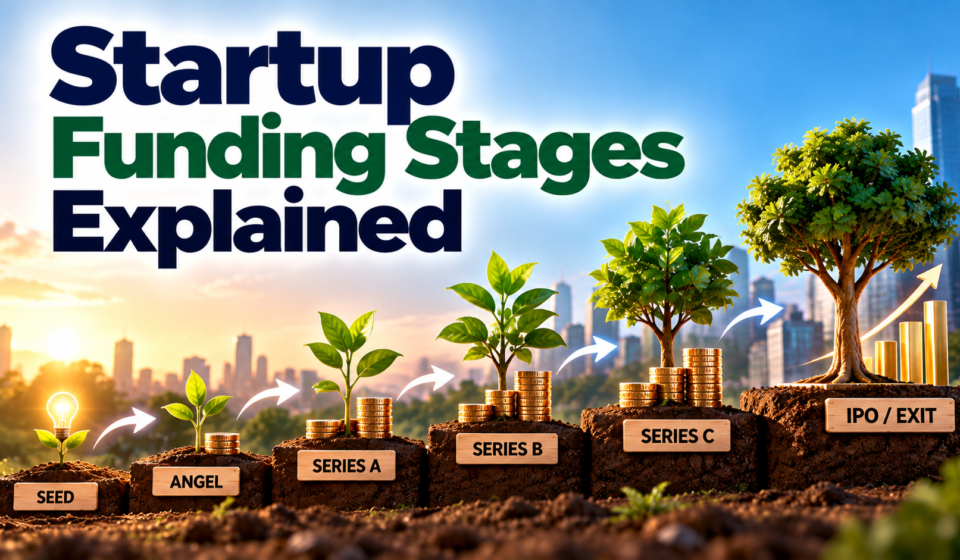

Starting a business often requires more than a good idea.
A founder may need money to develop a product, hire employees, test the market, acquire customers, expand operations, and build the infrastructure needed to support growth.
Startup funding provides capital for these activities.
However, startups do not usually raise all the money they need at once. Funding is commonly raised in stages as the company develops and reaches different milestones.
These stages help investors understand how much progress a startup has made, while founders can use each funding round to finance the next phase of development.
Understanding startup funding stages can make it easier to understand how young companies raise capital, what investors look for, and why the amount of funding required can change as a business grows.
What Is Startup Funding?
Startup funding is capital provided to a young company to help it develop and grow.
The money can come from different sources, including:
- Founders
- Friends and family
- Angel investors
- Venture capital firms
- Corporate investors
- Crowdfunding participants
- Banks and other lenders
- Government programs
- Strategic investors
The type of funding available often depends on the company’s development stage.
A founder with only an idea may have very different financing options from a company generating millions in annual revenue.
Why Startups Raise Money in Stages
Raising money in stages allows a startup to connect funding with measurable progress.
For example, a company may initially need $100,000 to build a prototype.
After demonstrating that customers want the product, it may need several million dollars to expand its team and launch in additional markets.
Later, the company may raise substantially more money to expand internationally.
Each funding stage is therefore connected to a different set of business objectives.
The Startup Funding Journey at a Glance
| Funding Stage | Typical Business Situation | Main Purpose of Funding | Common Investors |
|---|---|---|---|
| Bootstrapping | Idea or early development | Build and test the concept | Founders |
| Pre Seed | Early product development | Prototype, research, initial team | Founders, friends, family, angels |
| Seed | Early market validation | Product development and customer acquisition | Angel investors, seed funds |
| Series A | Early growth | Build a scalable business model | Venture capital firms |
| Series B | Expansion | Grow teams, customers, and markets | Venture capital firms |
| Series C and beyond | Established growth | Scale, expand, acquisitions | VCs, institutional investors |
| Late stage | Mature private company | Large scale expansion or preparation for exit | Institutional investors, growth funds |
These stages are general industry terms. Not every startup follows the same sequence, and some companies skip rounds or raise funding using different structures.
Before Venture Capital: Bootstrapping
Bootstrapping means building a company primarily with the founder’s own money and revenue generated by the business.
A founder might use personal savings to:
- Develop a website
- Build a prototype
- Purchase equipment
- Hire initial contractors
- Market the product
- Cover operating expenses
Bootstrapping can allow founders to retain greater ownership and control.
However, it can also limit the speed at which the business grows because expansion depends heavily on available personal capital and operating revenue.
Some successful businesses remain bootstrapped for a long time, while others eventually seek outside investors.
Pre Seed Funding
Pre seed funding is generally associated with the earliest stage of external startup financing.
At this point, the company may still be developing its product or testing whether a particular business idea can become commercially viable.
The startup may have:
- A business concept
- Early research
- A prototype
- An initial founding team
- Early customer conversations
Revenue may be minimal or nonexistent.
The money raised at this stage can be used to turn an idea into something that can be tested in the market.
What Investors May Look For
Early investors may focus heavily on the founders, the problem being addressed, the potential market, and the company’s proposed solution.
At such an early stage, there may not be enough financial history to evaluate the business using traditional metrics.
Seed Funding
Seed funding is generally used to help a startup establish an early business.
By this stage, the company may have developed a product and begun acquiring customers.
The startup may use seed capital to:
- Improve the product
- Hire employees
- Develop sales operations
- Acquire customers
- Test pricing
- Expand marketing
- Build technical infrastructure
The company is still likely to be relatively young and may not yet have a proven large scale business model.
Seed Investors
Seed funding can come from:
- Angel investors
- Seed venture capital firms
- Startup accelerators
- Founders
- Strategic investors
- Other early stage investors
The size of seed rounds varies significantly depending on the company, industry, geography, market opportunity, and investor interest.
Series A Funding
Series A is often associated with startups that have demonstrated some evidence of product market fit or meaningful market demand.
The company may have customers, revenue, user growth, or other evidence suggesting that the business model has potential to scale.
At this stage, investors may examine metrics such as:
- Revenue growth
- Customer acquisition
- Retention
- Gross margins
- Market size
- Unit economics
- Competitive position
- Product performance
The funding is often used to build a more scalable organization.
For example, a software company may use Series A funding to expand its engineering and sales teams, improve its platform, and enter additional markets.
Series B Funding
Series B generally occurs when a company has moved beyond early validation and is focused on expansion.
The startup may already have:
- A growing customer base
- Established revenue
- A larger team
- A proven product
- Repeatable sales processes
The company may use Series B funding to expand operations, increase marketing, enter new geographic markets, develop new products, or hire senior leadership.
At this stage, investors often have more operating data available than they did during seed or Series A fundraising.
Series C Funding
Series C and later rounds are generally associated with companies that have achieved significant growth and are looking to scale further.
A company may raise Series C funding to:
- Expand internationally
- Acquire another company
- Launch new product lines
- Increase production
- Enter new markets
- Strengthen infrastructure
- Expand its workforce
The company may also attract larger institutional investors that were less likely to invest at the earliest stages.
Series D and Later Rounds
Some companies continue raising additional private funding after Series C.
These rounds can finance major expansion or provide additional capital before an eventual liquidity event.
A startup may raise a Series D, E, or later round if it continues to grow while remaining private.
However, not every company reaches these stages.
Some startups are acquired before raising later rounds, while others become profitable and no longer need significant external funding.
What Is a Funding Round?
A funding round is a period during which a startup raises capital from investors.
For example, a company might announce that it has raised $8 million in a Series A round.
That does not necessarily mean the company receives money without giving investors anything in return.
Investors generally receive an ownership interest, a convertible instrument, or another financial claim depending on the structure of the transaction.
Equity Financing
Equity financing involves selling an ownership interest in the company in exchange for capital.
Suppose a startup is valued at $10 million before a new investment and raises $2 million.
The investor receives an ownership stake based on the negotiated terms.
The founders therefore own a smaller percentage of the company after the financing, assuming the investment results in newly issued shares.
This reduction in ownership is known as dilution.
Convertible Notes and Similar Instruments
Not every early stage investment is structured as an immediate sale of priced equity.
Some startups raise money through convertible notes or other instruments that can convert into equity under specified conditions.
These structures can allow companies and investors to postpone certain valuation decisions until a later funding round.
The exact terms can vary substantially.
Founders should understand conversion provisions, valuation caps, discounts, interest, maturity, and other terms before accepting such financing.
What Investors Evaluate
As startups move through funding stages, investors typically have more information available.
Early investors may focus heavily on:
- Founders
- Market opportunity
- Product concept
- Competitive advantage
Later stage investors can examine additional evidence such as:
- Revenue
- Customer growth
- Retention
- Profit margins
- Cash flow
- Sales efficiency
- Market share
- Operational performance
The metrics that matter depend heavily on the business model.
A subscription software company may be evaluated differently from a consumer goods company or biotechnology startup.
Valuation and Startup Funding
Startup valuation refers to the estimated value assigned to a company during an investment transaction or for other financial purposes.
Valuation can depend on factors such as:
- Revenue
- Growth rate
- Market opportunity
- Competitive position
- Intellectual property
- Customer base
- Business model
- Investor demand
- Comparable companies
- Future potential
Early stage valuations can be particularly difficult because young startups may have limited financial history.
This is one reason fundraising negotiations can involve significant uncertainty.
Dilution and Founder Ownership
One of the most important concepts founders need to understand is dilution.
Suppose a founder owns 100 percent of a startup before outside investment.
The company raises capital by issuing new shares to investors.
The founder’s percentage ownership will generally decrease.
This does not automatically mean the founder is worse off.
If the investment helps the company become substantially more valuable, the founder may own a smaller percentage of a much larger company.
The key issue is understanding how ownership changes alongside the company’s valuation and future prospects.
What Happens After a Funding Round?
Raising money is not the end of the process.
Investors typically expect the company to use the capital to achieve specific business objectives.
These might include:
- Reaching revenue targets
- Increasing customer numbers
- Launching products
- Expanding into new markets
- Improving margins
- Hiring key employees
- Building infrastructure
The company may eventually return to investors for another funding round.
This creates a progression in which each round is intended to finance the next stage of development.
When Startups Do Not Raise More Money
Not every startup needs continuous venture capital.
A company may reach profitability and finance its growth using revenue.
Another company may be acquired by a larger business.
A successful startup may eventually go public through an initial public offering.
Other companies may remain private for many years.
The funding path depends on the company’s business model, capital requirements, growth strategy, and founder objectives.
Startup Funding and the Path to an Exit
Investors generally provide capital because they expect an opportunity to eventually receive a financial return.
Potential liquidity events include:
Acquisition
A larger company purchases the startup.
Initial Public Offering
The company becomes publicly traded and its shares can be bought and sold on a public market.
Secondary Share Sale
Existing shareholders may sell some of their shares to another investor, subject to applicable restrictions and transaction terms.
Not every startup reaches an exit, and an investment in a private startup can result in partial or complete loss of capital.
Why Some Startups Raise More Than Others
Funding requirements vary significantly between businesses.
A software company may be able to develop an initial product with a relatively small team.
A biotechnology company may require extensive research, laboratory facilities, testing, and regulatory work before generating commercial revenue.
A manufacturing startup may need factories, equipment, inventory, and supply chain infrastructure.
Therefore, comparing funding amounts between startups without considering their industries and business models can be misleading.
Common Startup Funding Mistakes
Raising Too Much Too Early
Large amounts of capital can create pressure to grow faster than the business is ready to support.
Raising Too Little
Insufficient capital can make it difficult to reach the milestones needed for the next stage.
Focusing Only on Valuation
A high valuation may look attractive, but investors and founders also need to consider ownership, control, liquidation preferences, conversion terms, and other provisions.
Ignoring Dilution
Founders should understand how each financing round affects their ownership.
Spending Without Clear Milestones
Funding should support measurable business objectives rather than simply increasing expenses.
Final Thoughts
Startup funding is generally a progression rather than a single event.
A company may begin with founder capital, move into pre seed and seed financing, and then raise Series A, Series B, Series C, and later rounds as it develops.
Each stage represents a different point in the company’s journey.
Early investors often have limited financial information and may focus heavily on the founders, product, and market opportunity. Later investors can evaluate a larger amount of operating data, including revenue, customer growth, margins, retention, and other business metrics.
For founders, raising capital also means making decisions about ownership, dilution, valuation, investor rights, and how the money will be used.
For investors, understanding the funding stage provides context about the company’s maturity, capital requirements, risks, and growth plans.
There is no universal funding path for every startup. Some companies remain bootstrapped, some raise several venture rounds, some become profitable without extensive outside capital, and others are acquired or go public.
The most important point is to understand what each funding stage is intended to accomplish and how the financing affects the company as it moves toward its next milestone.
Frequently Asked Questions
What are the main stages of startup funding?
Common stages include bootstrapping, pre seed, seed, Series A, Series B, Series C, and later stage funding. Not every startup goes through all of these stages.
What is pre seed funding?
Pre seed funding is early capital used to develop an idea, prototype, initial product, or founding team. It often occurs before a startup has significant revenue.
What is seed funding used for?
Seed funding can be used to develop products, acquire early customers, hire employees, test business models, and establish the foundations of the company.
What is Series A funding?
Series A is generally associated with startups that have demonstrated early evidence of market demand and are seeking capital to develop a scalable business.
What happens during Series B?
Series B funding is generally used to support expansion after a company has established more evidence of product market fit and business performance.
What is Series C funding?
Series C and later rounds are generally associated with companies seeking significant additional capital for expansion, acquisitions, international growth, or other large scale initiatives.
Do all startups need venture capital?
No. Some startups are bootstrapped, funded through revenue, supported by grants, or financed through other sources.
What is startup dilution?
Dilution occurs when new shares or ownership interests are issued and an existing shareholder’s percentage ownership decreases.
Does dilution always mean founders lose money?
Not necessarily. A founder may own a smaller percentage of a company after fundraising, but the overall value of that stake could increase if the company’s value grows.
How do startup investors make money?
Investors can potentially receive returns through events such as acquisitions, public offerings, secondary sales, or other liquidity events. Startup investments can also lose some or all of their value.
What is a startup valuation?
A startup valuation is an estimate or negotiated assessment of a company’s value. It can be influenced by financial performance, growth, market opportunity, competition, intellectual property, investor demand, and other factors.
Can a startup skip a funding stage?
Yes. Funding stages are not mandatory steps. Some companies raise large rounds early, while others remain bootstrapped or move directly from one stage to another.
Why do startups raise multiple funding rounds?
Companies often raise multiple rounds because their capital requirements increase as they grow. Each round can provide funding for the next set of business milestones.
What should founders consider before raising funding?
Founders should consider the amount of capital required, valuation, dilution, investor rights, control provisions, repayment or conversion terms, future fundraising requirements, and how the capital will be used.